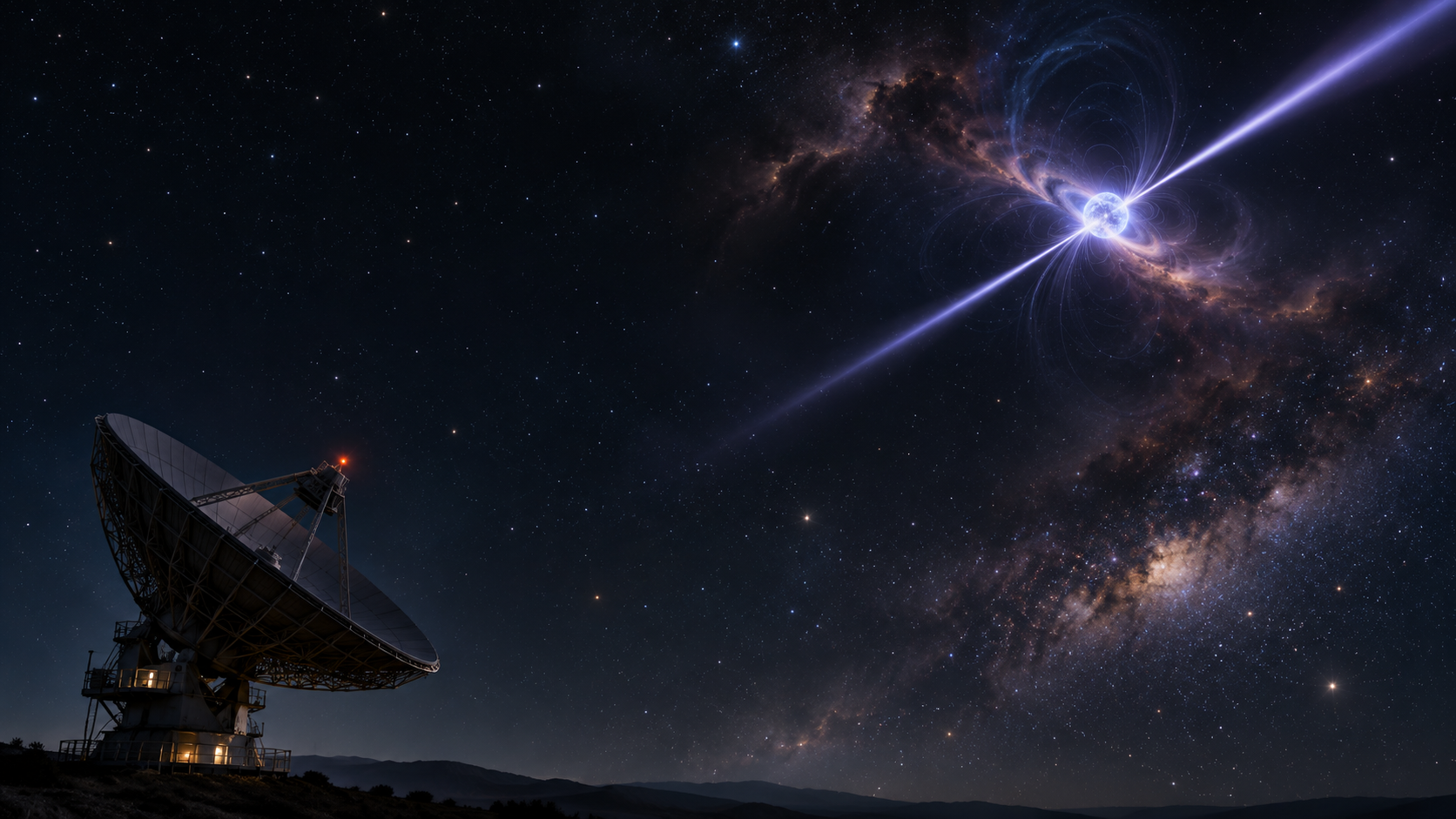
What Makes Up the Cosmos? Evidence of Missing Physics
What Makes Up the Cosmos? Evidence of Missing Physics
Modern astronomy has a strong, though incomplete, answer to what makes up the universe. Scientists describe the cosmos as a mixture of ordinary matter, dark matter, dark energy, radiation, and neutrinos. Together, these components explain much of cosmic history, from the formation of the first atoms to the growth of galaxies.
However, a long-running cosmic survey has added to concerns that the standard picture may not explain everything observers see. The findings do not prove that a new particle, force, or dimension exists. They could reflect measurement errors, an incomplete understanding of familiar cosmic components, or genuinely new physics. Source 1
The central issue is cosmic accounting: do known forms of matter and energy explain the universe’s expansion, structure, and evolution, or is an important ingredient missing?
What Makes Up the Universe?
Ordinary Matter
Ordinary, or baryonic, matter consists of atoms and their constituent particles. It forms stars, planets, galaxies, gas clouds, dust, and living organisms.
Although it is the matter most familiar to us, it represents only a small share of the universe’s total mass-energy budget. Much ordinary matter exists as thin gas and plasma between galaxies, detectable through the light it absorbs or emits.
Astronomers identify ordinary matter through telescopes and spectroscopy. Each chemical element leaves characteristic fingerprints in light, revealing the composition, temperature, motion, and density of distant stars and clouds.
Stars and galaxies also serve as markers of distance and cosmic time. Yet visible matter alone cannot explain galaxy rotation or the formation of large-scale cosmic structure.
Dark Matter
Dark matter is the name given to an unseen form of matter that appears to interact through gravity but does not emit, absorb, or reflect light in the ordinary way.
Its existence is inferred from several observations:
- The outer regions of galaxies rotate faster than visible matter alone can explain.
- Gravitational lensing reveals more mass than telescopes can see.
- Dark matter helps explain the formation of galaxies and galaxy clusters.
- Patterns in the cosmic microwave background match models containing substantial invisible mass.
Dark matter differs from dark energy. Dark matter attracts through gravity and helps matter gather into structures. Dark energy is associated with the accelerating expansion of space.
The identity of dark matter remains unknown. It could consist of a new particle or particles outside the Standard Model of particle physics. Decades of experiments have searched for direct evidence, but gravitational observations remain the strongest indication that dark matter exists.
Dark Energy
Dark energy describes whatever causes the expansion of the universe to accelerate. Observations of distant supernovae showed that cosmic expansion has sped up over time rather than continuing at a constant rate.
The simplest explanation is a cosmological constant, usually represented by the Greek letter lambda. In this model, dark energy has a fixed density that remains constant as space expands. This assumption forms part of the Lambda Cold Dark Matter, or ΛCDM, model.
Dark energy may not be constant, however. Recent evidence discussed by Quanta Magazine has strengthened the possibility that its effective influence changes over cosmic time. Such a result would challenge the simplest version of the standard cosmological model, although it would not prove a specific alternative theory. Source 7
Radiation and Neutrinos
Radiation includes photons and other particles moving at, or close to, the speed of light. The early universe contained a hot mixture of radiation and matter. As expansion continued, the universe cooled, allowing atoms, stars, and galaxies to form.
Neutrinos are extremely light particles that interact very weakly with ordinary matter. They come from the Sun, supernovae, radioactive decay, nuclear reactors, and the early universe.
Because neutrinos rarely collide with atoms, they can pass through enormous amounts of matter. Large detectors identify the rare interactions that do occur. Source 3
Neutrinos were abundant in the early universe, and their masses and motion affected how matter clumped. Fast-moving neutrinos can suppress the growth of smaller structures, influencing the distribution of galaxies today.
The Standard Cosmological Model and Its Limits
The standard cosmological model is commonly expressed through the ΛCDM framework. It includes:
- Ordinary matter
- Cold dark matter
- A cosmological constant representing dark energy
- Radiation
- Neutrinos and other light particles
ΛCDM successfully describes the overall expansion of the universe, the cosmic microwave background, the distribution of galaxies, the formation of large-scale structure, and the abundance of light elements produced shortly after the Big Bang.
Its success across many areas of astronomy is clear. The difficulty is that several precise measurements do not fit together as easily as expected.
A mismatch does not automatically mean that the model is wrong. It may result from a revised parameter, an overlooked calibration problem, an incompletely understood astrophysical process, a missing component, or a new physical law.
The 20-year survey should therefore be viewed as part of a wider pattern of scrutiny rather than as a definitive disproof of ΛCDM. Long-term observations are valuable because they can reveal trends that survive repeated analysis and comparison with independent datasets. Source 1
What the 20-Year Survey May Reveal
Observations collected over two decades can reduce random errors and show whether a pattern persists. Repeated measurements allow researchers to compare different cosmic epochs, test predictions, and distinguish temporary anomalies from systematic trends.
The central implication is not that astronomers have found a missing visible object. Rather, the current inventory may lack enough explanatory power to reproduce some observations of cosmic expansion or structure.
Possible explanations include evolving dark energy, unusual dark matter properties, unexpected neutrino behavior, modified gravity, or an unidentified observational bias.
The Hubble Tension
The Hubble constant describes the present-day expansion rate of the universe. It is used to estimate cosmic distances, ages, and the history of expansion.
Different methods produce different values. One approach studies the early universe through the cosmic microwave background and uses ΛCDM to calculate the expansion rate today. Another measures the late universe using standard candles, including Cepheid variable stars and supernovae.
The disagreement between these approaches is known as the Hubble tension. It may result from systematic errors, incomplete modeling, or new physics. Source 9
Distance-ladder measurements involve telescope calibration, stellar behavior, supernova properties, selection effects, and data analysis. A small bias in one step could affect the final result.
If early- and late-universe measurements are both correct, the standard model may omit a component or process that changes cosmic evolution between those eras. Researchers need more precise observations, independent distance indicators, improved calibration, and cross-checks between telescopes and surveys.
Could Dark Energy Be Changing?
The cosmological constant is attractive because it provides a simple explanation for accelerated expansion. Its density remains stable as space expands, allowing cosmologists to model the universe’s past and future with relatively few parameters.
Dark energy could instead be a dynamic field whose strength varies over time. In that case, the expansion history would differ from the constant-energy prediction.
Recent observations have strengthened the possibility that dark energy may be weakening or changing over cosmic time. This does not necessarily mean that dark energy is disappearing; its effective influence may simply evolve as the universe changes.
If confirmed, the result could alter predictions for future expansion, the growth of galaxies and clusters, and the long-term fate of cosmic structures. Additional surveys and independent analyses must determine whether the apparent trend is physical or a consequence of data limitations. Source 7
Could Neutrinos Explain Part of the Discrepancy?
Neutrinos interact mainly through the weak nuclear force and gravity. They do not respond to electromagnetism, so light cannot reveal them directly. Their weak interactions allow them to pass through matter with little disturbance.
Neutrinos were plentiful in the early universe, and their motion influenced the growth of cosmic structure, particularly on smaller scales. Their total mass affects how strongly they suppress clustering.
Unexpected neutrino interactions or properties could change cosmological predictions and reveal physics beyond the current particle framework. However, existing evidence does not show that neutrinos alone explain all cosmological discrepancies.
The Dark Dimension Hypothesis
One speculative proposal describes a “dark dimension” that could connect dark matter and dark energy. The idea seeks a shared explanation for two of cosmology’s largest mysteries: the nature of invisible mass and the source of accelerated expansion. Source 5
In physics, a dimension is an additional direction or structure in a mathematical theory, not simply another planet or hidden location. An extra dimension could alter how gravity, particles, or fields behave across different scales.
The concept remains speculative. It requires mathematical consistency, agreement with existing observations, testable predictions, and experimental or observational confirmation. An elegant connection between dark matter and dark energy is not evidence by itself.
What Could Be Missing?
An Unknown Particle or Field
Dark matter may consist of particles not included in the Standard Model. Dark energy could involve a field whose strength changes across time or space. Direct detection remains difficult because dark matter may interact extremely weakly, while dark energy may influence the universe only across enormous distances.
Modified Gravity
Gravity might behave differently over intergalactic distances. Modified-gravity theories could change predictions for galaxy motion, gravitational lensing, cosmic expansion, and structure formation.
Any such theory must explain evidence currently attributed to dark matter and dark energy while matching the many successful predictions of general relativity and ΛCDM.
A Hidden Measurement Bias
Cosmological measurements depend on complex instruments, models, and calibration chains. Biases can arise from telescope performance, distance-ladder calibration, astrophysical assumptions, sample selection, or statistical methods.
Finding a systematic error would not make the research pointless. It would improve the reliability of cosmic measurements and clarify which theories remain viable.
How Scientists Will Test These Possibilities
New surveys can map galaxies, supernovae, gravitational lensing, and large-scale structure across greater distances and cosmic eras. Comparing independent datasets can reveal whether dark energy changes over time or whether an apparent trend comes from one method.
Neutrino observatories and underground detectors can improve measurements of neutrino mass, oscillations, and interactions. Laboratory results can constrain cosmological models and narrow the range of possible dark matter theories.
Astronomers also compare standard candles, such as supernovae, with standard rulers, such as characteristic features in the distribution of galaxies. Gravitational waves may eventually provide another independent distance method.
Agreement among these approaches would reduce the chance that one measurement technique contains a hidden bias. Continued disagreement would strengthen the case for new physics.
What This Means for Our Understanding of the Universe
Scientists understand the broad composition of the cosmos but not the identity of its dominant components. Ordinary matter is familiar but minor. Dark matter shapes structure but remains unseen. Dark energy dominates the cosmic energy budget but may not be constant.
The standard cosmological model remains an effective description of a vast range of observations. Unresolved tensions do not erase its successes; they show where its predictions require more careful testing.
The 20-year survey adds to the need for precise measurements and open comparison between competing explanations. The model may require refinement without being abandoned. A discrepancy may reveal a new particle, an evolving field, modified gravity, or a calibration problem.
The key distinction is between evidence that a model is incomplete and proof of a particular replacement. The cosmos may be missing something from our equations, but researchers still need observations that identify it.
FAQ
What makes up most of the cosmos?
The universe is thought to consist primarily of dark energy and dark matter. Ordinary matter, radiation, and neutrinos make up much smaller portions. The nature of dark matter and dark energy remains unknown.
What does the 20-year cosmic survey suggest?
It suggests that current models may not fully explain all observations. Possible interpretations include evolving dark energy, unusual particle properties, modified gravity, or unresolved measurement errors.
Is dark energy weakening over time?
Some recent evidence is consistent with the possibility that dark energy changes or weakens over cosmic time. The interpretation remains under investigation and requires confirmation from additional observations.
What is the Hubble tension?
The Hubble tension is the disagreement between measurements of the universe’s expansion rate derived from early-universe observations and late-universe methods. It may result from systematic errors, incomplete modeling, or new physics.
Could neutrinos explain what is missing?
Neutrinos influence cosmic structure and may reveal physics beyond current theories. Existing evidence does not show that neutrinos alone explain all discrepancies in cosmology.
Is the dark dimension a confirmed discovery?
No. The dark dimension is a speculative theoretical idea connecting dark matter and dark energy. It requires stronger mathematical, observational, or experimental support before it can become an accepted explanation.