Suspected Drone Attack Hits Russian Ship Near Benghazi
Suspected Drone Attack Hits Russian Ship Near Benghazi
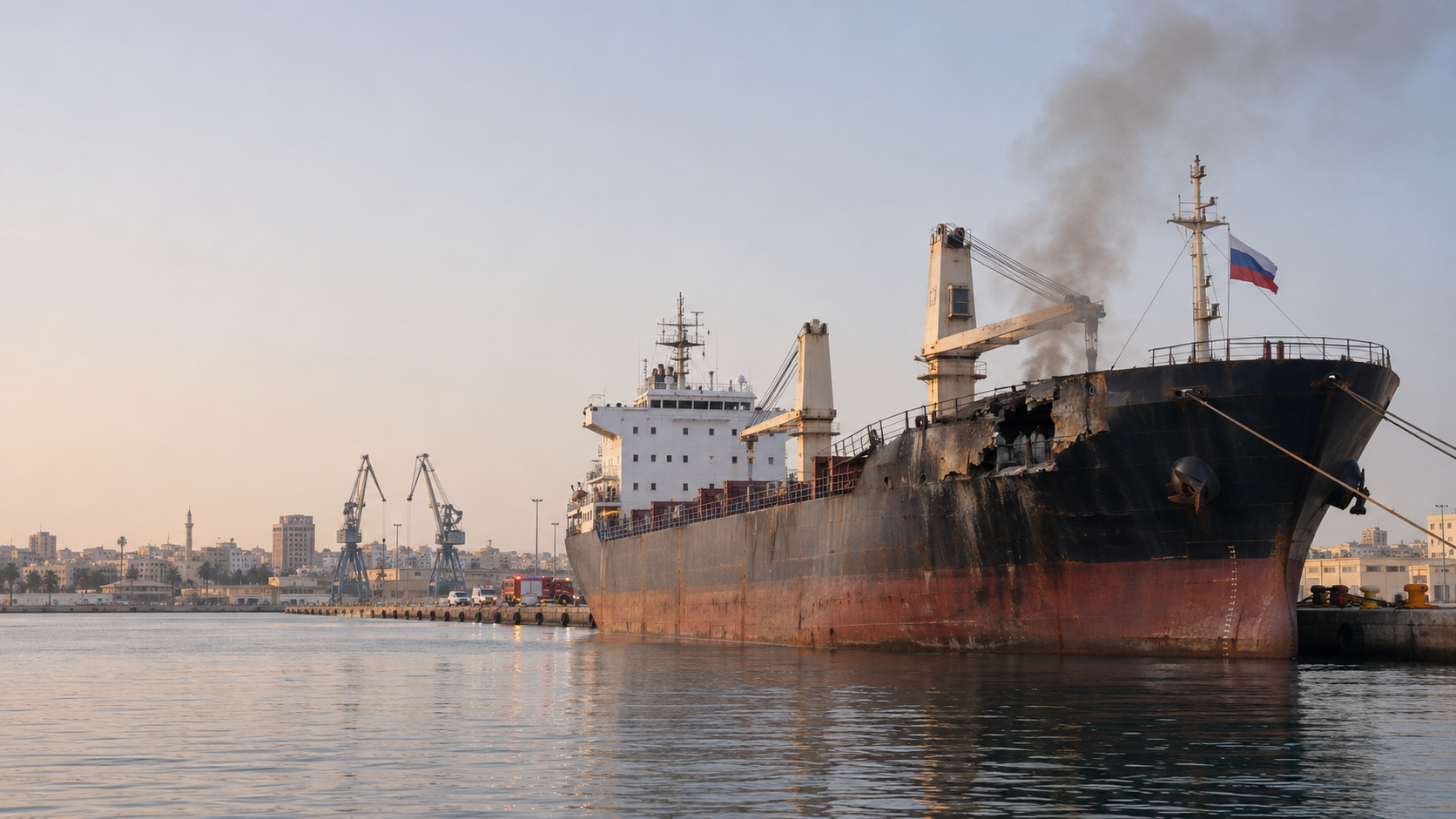
Reports from Libya and international media say that a Russian vessel was struck by a suspected unmanned maritime drone in or near Benghazi. Some accounts described a drone boat, while others alleged that the weapon may have been a Ukrainian sea drone.
The central facts remain unsettled. Available reporting does not independently establish the vessel’s identity, the precise location, the extent of the damage, whether there were casualties, or who launched the suspected attack.
One report identified the vessel as the Russian corvette Merkury and claimed that it capsized. That allegation has not been independently confirmed in the available source material.
What Happened?
Libyan officials were reportedly cited as saying that a Russian warship was hit by a suspected Ukrainian drone at a naval facility in Benghazi. Other reports placed the vessel near the city or off the Libyan coast rather than inside a naval base.
Radio Free Europe/Radio Liberty reported that a suspected drone boat struck a Russian vessel near Benghazi, raising questions about possible links to the war in Ukraine. Source 1
CNN was also cited in reports that a Russian vessel docked in Libya had reportedly been hit. The available summary does not provide verified details about the timing, damage, or weapon. Source 3
France 24 reporting used stronger language, describing a Russian warship allegedly hit by a suspected Ukrainian drone at a Benghazi naval base. Source 9
These reports agree on the broad outline: a Russian vessel was reportedly struck in or near Benghazi by a suspected unmanned maritime weapon. They differ over the exact location, the vessel’s classification, and the severity of the damage.
Location Remains Unclear
Some accounts place the incident at a naval base in Benghazi, suggesting that the vessel may have been attacked while docked or operating inside a protected harbor. Others describe the ship as being near Benghazi or off the Libyan coast.
The distinction matters. An attack inside a military harbor would raise questions about surveillance, coastal defenses, and the protection of foreign vessels. An offshore strike would point to a different operational picture involving maritime patrols and the detection of small unmanned surface vessels.
The available summaries contain no official imagery, maritime tracking data, or geolocated video that establishes the precise site. The incident should therefore be described as occurring “in or near Benghazi,” rather than definitively inside a naval base.
Was the Vessel the Merkury?
Most reports refer only to a Russian ship or warship. SOFX identified the target as the Russian corvette Merkury and claimed that Ukrainian sea drones capsized it. Source 7
The supplied material contains no independent imagery, official Russian statement, maritime evidence, or visual analysis confirming that identification or the claim that the vessel capsized.
Verification would require evidence such as:
- Satellite imagery showing the vessel in Benghazi.
- Geolocated photographs or video.
- A Russian naval statement.
- Independent maritime reporting.
- Visual details matching the corvette’s design.
- Evidence of the vessel’s movements before and after the incident.
Until such evidence appears, the safest description is “a Russian vessel reportedly operating in or near Benghazi.”
What Weapon Was Used?
Reports refer to a drone boat, sea drone, or unmanned surface vessel. These terms generally describe a remotely operated or autonomous craft that can carry an explosive payload.
The available reporting does not establish the drone’s model, size, range, payload, launch location, guidance method, or whether the craft was recovered. Some accounts attributed the attack to a Ukrainian drone, but that remains an allegation rather than a confirmed conclusion.
A weapon’s design may suggest a possible origin, but it does not prove who planned, launched, or supplied the operation.
Damage and Casualties Are Unconfirmed
The available summaries provide no verified information about deaths or injuries. They also do not establish whether the vessel sank, capsized, suffered limited damage, or remained operational.
Important unanswered questions include:
- Was the vessel struck once or multiple times?
- Where did the explosion occur?
- Was the ship inside a harbor or offshore?
- Did port infrastructure or nearby vessels suffer damage?
- Did the vessel require repair or towing?
- Were crew members evacuated?
Early maritime attack reports can combine eyewitness accounts, official statements, social media material, and anonymous claims. Those elements may show that an incident warrants investigation, but they do not establish the complete chain of events.
Was Ukraine Responsible?
Some reports described the suspected weapon as Ukrainian. None of the supplied source summaries includes a Ukrainian government admission, independently verified wreckage analysis, a confirmed launch location, or forensic evidence linking Kyiv to the attack.
Attribution requires separate answers to several questions:
- Who operated the drone?
- Where was it launched?
- Who planned the mission?
- Who supplied the technology?
- Who authorized the attack?
Evidence that could strengthen a Ukrainian attribution would include geolocated video, satellite imagery, navigation data, communications records, wreckage analysis, and official statements from Libya, Russia, or Ukraine. Independent maritime tracking data could also help determine whether the vessel was inside port or offshore.
Until such evidence becomes available, the incident should be described as a suspected drone attack with unconfirmed attribution.
Why Would a Russian Vessel Be in Benghazi?
Benghazi is a major political, military, and commercial center in eastern Libya. Its location on the Mediterranean gives it strategic importance for regional logistics and security networks.
Russia has developed relationships with actors in eastern Libya. A Russian vessel in the area could have been involved in naval logistics, personnel or equipment movement, port support, regional patrols, or a military or diplomatic visit. The available reports do not identify its mission, and the vessel’s presence does not by itself prove a specific formal military agreement between Russia and Libya.
Libya’s fragmented political and security environment further complicates the incident. Competing authorities, armed groups, and foreign partners have shaped security policy since the country’s political division deepened. Any foreign military activity can therefore carry local political significance.
Why the Incident Matters
Libya’s Security Environment
An attack on a foreign military vessel could increase pressure on authorities in eastern Libya. Possible consequences include tighter security around Benghazi’s ports, restrictions on foreign vessels, and competing narratives among local factions.
Even a limited strike could demonstrate that a supposedly secure port is vulnerable to low-cost maritime systems.
Russia’s Military Presence
Russia could respond by increasing protection for its personnel, ships, and port facilities. Possible measures include additional patrols, harbor barriers, surveillance systems, and stricter movement procedures.
The incident could also affect Russia’s relationship with eastern Libyan partners. Moscow may seek assurances that its assets can operate safely, while local authorities may face pressure to improve port security and identify those responsible.
The available material does not establish what response Russia has taken or whether it plans a specific military action.
Ukraine’s Strategic Reach
If Ukrainian responsibility were confirmed, the incident would raise questions about the geographic reach of Ukraine’s maritime-drone campaign. It would also suggest that Russian assets outside the Black Sea could face risks in distant ports and logistics hubs.
Those implications depend on establishing that Ukraine directed or supported the operation.
Maritime Security
Uncrewed surface vessels create new challenges for naval and port authorities. They can be difficult to detect, operate close to shore, and threaten ships while they are docked.
Ports may require stronger radar and optical surveillance, harbor barriers, patrol coverage, access controls, electronic monitoring, and procedures for identifying suspicious small craft.
Reported United Nations Call for an Investigation
France 24 reported that the United Nations called for an investigation after the Russian ship was attacked off Libya. Source 5
A call for an investigation is not a finding that Ukraine carried out the attack. It signals the need to establish what happened, which weapon was used, and whether international law was violated.
Investigators could examine port surveillance footage, ship damage and blast patterns, drone debris, the vessel’s registration and military status, Automatic Identification System data, satellite imagery, witness testimony, communications records, and security logs.
Access may be difficult because military sites are sensitive and different actors may control relevant evidence. Conflicting official narratives and wartime information operations could also delay a reliable conclusion.
Confirmed Facts and Unconfirmed Claims
Supported by Multiple Source Summaries
- A Russian vessel was reportedly hit in or near Benghazi.
- The incident allegedly involved a drone or drone boat.
- Libyan officials and international media were cited in the reporting.
- Some accounts linked the suspected attack to Ukraine.
- France 24 reported a United Nations call for an investigation.
Still Unconfirmed
- The exact date and time.
- The precise location.
- The vessel’s name and class.
- Whether it was a warship, corvette, or another Russian vessel.
- The extent of the damage.
- Whether the vessel capsized or sank.
- The number of casualties.
- The attacker’s identity.
- The drone’s model and payload.
- The launch point.
- The vessel’s mission in Libya.
The most accurate editorial language remains: “a suspected attack,” “reports said,” “officials reportedly stated,” and “the available reporting does not establish.”
Conclusion
Reports indicate that a Russian vessel was struck in or near Benghazi by a suspected unmanned maritime drone. The incident has prompted speculation about a possible Ukrainian operation, but responsibility remains unconfirmed.
The vessel’s identity, the extent of the damage, the precise location, and the attacker’s identity require further evidence. The reported United Nations call for an investigation could help separate documented facts from wartime claims.
The next developments may include official statements from Libya and Russia, satellite or video evidence, damage assessments, and findings from international investigators. Those developments will determine whether the Benghazi incident was an isolated maritime attack or part of a broader expansion of the Russia-Ukraine conflict.
Frequently Asked Questions
Was a Russian ship attacked in Benghazi?
Reports from Libyan officials and international media said that a Russian vessel was hit in or near Benghazi. The available reporting does not independently confirm every detail.
Was the attack carried out by Ukraine?
Some reports described the weapon as a suspected Ukrainian drone or sea drone. Responsibility has not been conclusively established in the supplied sources.
Was the Russian vessel the corvette Merkury?
SOFX claimed that Ukrainian sea drones capsized the Russian corvette Merkury. The vessel’s identification and the claim that it capsized remain unverified.
What type of drone was allegedly used?
Reports referred to a drone boat, sea drone, or unmanned maritime vessel. No supplied source confirms the model, payload, or launch location.
Did anyone die in the attack?
The available source summaries provide no verified information about deaths or injuries. Official casualty information would be required for confirmation.
Why is the incident significant?
The reported attack could affect Russian military activity in Libya, port security in the Mediterranean, and perceptions of the Russia-Ukraine conflict’s geographic reach. Its significance depends on confirming the vessel, damage, and attacker.
Related Articles
-
 COP31 Climate Talks End Without Agreement
-
 Ukraine Threatens Russia’s Crimea Supply Lifeline
-
 Genocide Rulings: Legal Significance and Global Impact
-
 Army Delays Planned Detonation of Chemicals in Iowa
-
 Democrats Reportedly Win Largest House Majority Since 1992
-
 ICE Airport Detention Video Sparks Seattle Protests
-
 Chicago Park Rat Infestation: What the Evidence Shows
-
 COP31: Six Key Takeaways on Climate Action
-
 Russian Vessel Hit by Suspected Drone in Benghazi
-
 Can Trump Deliver Security for Ukraine?
-
 Lebanese Villagers Return to Damaged Homes
-
 Chuck Hubbard Victory: What Reports Confirm, What's Unclear
-
 Bay Area Flood Threat: Airport and Travel Safety Guide
-
 El-Sayed’s View on Private Insurance Under Medicare for All
-
 U.S. Army Iowa Lead Azide Disposal Plan Faces Court Stay
-
 COP31 Talks Collapse in Turkey Over Fossil Fuels