How Ukraine Struck the Kerch Bridge—and Why It Matters
How Ukraine Struck the Kerch Bridge—and Why It Matters
The Kerch Bridge is more than a road and rail crossing. It connects Russia’s Krasnodar region with Crimea, a Ukrainian peninsula occupied and claimed by Russia since 2014. It also represents one of the Kremlin’s clearest claims that Crimea has been permanently absorbed into Russia.
When the bridge was damaged in an attack attributed to Ukraine, the consequences extended beyond transport delays. The incident disrupted a major route, raised questions about Russian security, and challenged the image of control that the bridge was built to project. Ukrainian President Volodymyr Zelensky described the operation as “unprecedented,” according to a BBC summary supplied for this article (Source 3).
The available reporting attributes the attack to Ukraine but does not establish every operational detail. The exact weapon, launch method, number of devices, and planning process should not be treated as confirmed without independent evidence. What is clearer is the attack’s broader significance: it struck a logistical route and a political symbol at the same time.
Why the Kerch Bridge Matters
A transport link to occupied Crimea
The bridge crosses the strait between Russia and Crimea. Its road and rail connections support civilian travel, commercial deliveries, and military logistics. The structure gives Russia a direct land link to the peninsula, reducing its dependence on maritime transport and routes through occupied Ukrainian territory.
That role became especially important after Russia launched its full-scale invasion of Ukraine in February 2022. Crimea has served as a military hub, staging area, supply base, and transportation corridor for Russian operations in southern Ukraine.
The bridge therefore has several identities. For civilians, it is a crossing used for travel and trade. For the Russian military, it is part of a wider logistics network. For Ukraine, it is infrastructure supporting the occupation of its territory.
Ukraine and most of the international community reject Russia’s annexation of Crimea. The bridge’s existence does not change that legal position. Instead, its construction and operation have been used by Moscow to reinforce the claim that Crimea is integrated into Russia.
A Kremlin prestige project
The bridge is closely associated with Vladimir Putin’s presidency. Its construction was presented as proof that Russia could physically connect Crimea to the mainland after the 2014 annexation. The project conveyed permanence: Russia would not merely occupy Crimea but incorporate it into the country’s infrastructure and political system.
That symbolism made the bridge a prominent target in Ukraine’s campaign against Russian military assets and occupation structures. The Guardian’s supplied summary describes the crossing as both a key link to Crimea and a symbol of Putin’s rule (Source 1).
The Atlantic Council summary characterizes the strike as a humiliation that challenged Russia’s image of control over Crimea (Source 5).
A military target with symbolic value
The bridge combines practical and political value. Disrupting it can complicate the movement of supplies, increase inspection requirements, delay traffic, force rerouting, and create uncertainty. Images of damaged sections can also undermine claims that Russia has secured and integrated the peninsula.
A strike does not need to destroy the entire crossing to have an effect. Temporary disruption can impose military, economic, and political costs while demonstrating that Crimea remains contested.
What Happened in the Attack?
Reported physical damage
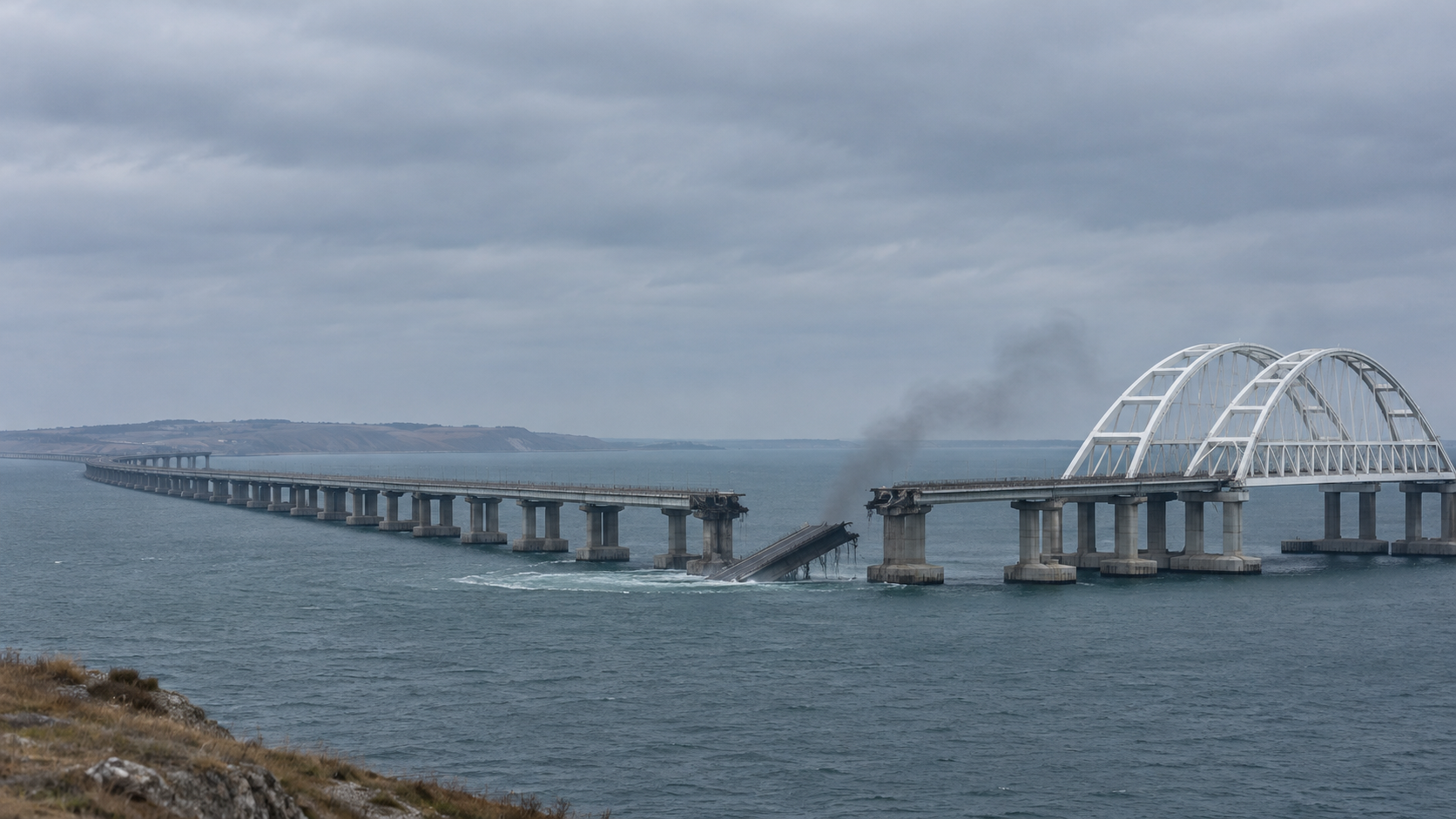
The BBC summary states that the Crimean Bridge partly collapsed after an attack attributed to Ukraine (Source 3). The report indicates substantial damage to part of the structure but does not establish that the entire bridge was destroyed or that every transport route was eliminated.
Partial structural damage can produce different effects for road and rail traffic. Authorities may close lanes, impose weight restrictions, conduct inspections, or suspend movement while engineers assess the crossing. Rail operations may face separate safety requirements from road traffic.
The duration and scale of the disruption require careful sourcing. Initial reports often describe immediate damage before repairs, alternative routes, and official restrictions are fully assessed.
What is known about responsibility?
The supplied reporting identifies Ukraine as responsible or likely responsible. Ukrainian officials presented the operation as a major success and described it as an attack on infrastructure supporting Russian control of Crimea. Russian officials have generally framed attacks on the bridge as aggression or terrorism and used them to justify stronger security measures and retaliation.
Those political positions do not answer every operational question. Attribution can be sufficiently clear for political analysis while remaining incomplete at the technical level. Governments may withhold information about intelligence, planning, or military capabilities, while journalists may rely on officials or unnamed sources that provide broad attribution without revealing evidence.
What remains unclear?
The supplied summaries do not verify:
- The exact weapon or platform used.
- The launch location.
- The number of devices involved.
- The route taken by any device.
- The intelligence and planning process.
- The precise role of Ukrainian military or security agencies.
- The full extent of the damage.
- The length of the disruption.
Social-media posts and unattributed channels may offer detailed explanations, but those claims should not be presented as established fact. A responsible account separates official statements, independent reporting, and confirmed physical evidence.
How Could Ukraine Reach a Protected Strategic Target?
A bridge is fixed and highly visible, but that does not make it invulnerable. Its approaches, traffic patterns, maintenance systems, and surrounding waters create a complex security environment. Authorities must protect the structure while allowing civilian movement and managing ordinary maritime and road activity.
Continuous protection is difficult. Surveillance systems can have gaps, security personnel must distinguish routine activity from hostile action, and several agencies must coordinate across airspace, waterways, traffic, intelligence, and emergency response.
Air defenses, checkpoints, maritime patrols, cameras, barriers, and inspections can reduce risk but cannot guarantee that every threat will be detected or stopped. A weakness may result from delayed communication, an unrecognized pattern, a technical failure, or uncertainty about whether an object or vehicle is hostile.
The exact method used against the bridge remains uncertain in the supplied reporting. Technical accounts should therefore avoid speculation and exclude procedural details that could help readers plan attacks against infrastructure.
Immediate Effects on Transport and Logistics
Damage to a bridge can affect more than the collapsed section. Authorities may close undamaged portions for inspections, restrict heavy vehicles, or suspend rail traffic until structural assessments are complete.
Potential consequences include:
- Delays for civilian travelers.
- Congestion at alternative crossings and ports.
- Slower movement of fuel and food.
- Higher transport and security costs.
- Delayed military deliveries.
- Additional inspection and scheduling requirements.
Russia can attempt repairs, reroute traffic, or increase its use of maritime and land connections. The operational effect depends on how long the damaged section remains unavailable and how much replacement capacity exists.
The bridge is one part of Russia’s wider supply network, not the only route to Crimea. Disruption can nevertheless make military logistics slower and more complicated. Possible effects include greater reliance on alternative roads, rail lines, ports, and routes through occupied territory. Those alternatives may be longer, less efficient, or more exposed to further attacks.
Newsweek’s supplied summary examines how the attack could hinder Russian military operations and the broader war effort (Source 9).
The strike should not be described as ending Russian logistics to Crimea. It created disruption and pressure, but isolating the peninsula would require the sustained loss of multiple routes.
Civilian consequences
Civilian effects are separate from military consequences. Travelers may face closures, queues, inspections, or uncertainty about whether they can cross. Local businesses can suffer when tourism declines or deliveries become less predictable. Food, fuel, and other goods may become more expensive if transport costs rise.
Emergency services can also face delays. Restrictions intended to protect the bridge may interfere with routine movement between Crimea and Russia. The public impact can become politically significant even when the military effect is limited because a damaged bridge reminds civilians that the war has reached a structure presented as secure and permanent.
Russia’s Response
Russian authorities face a difficult communications problem after damage to the bridge. They must explain the incident, protect the crossing, manage traffic, and promise repairs without appearing unable to defend a flagship project.
Likely measures include increased inspections, tighter access controls, expanded surveillance, traffic restrictions, and greater protection around nearby infrastructure. These steps may reduce future risks but also make the bridge less convenient for civilians and less efficient as a transport route.
Official statements may emphasize responsibility, retaliation, and restoration. The central message is that the state remains in control, even when the damage challenges that claim.
The supplied KTVQ summary says Russia retaliated by striking bridges in Kyiv (Source 7). That report is dated November 17, 2026, in the supplied material and requires verification before publication, including confirmation of the event, date, targets, and independent evidence.
Attacks on bridges and other infrastructure raise serious humanitarian and legal concerns. Their legality depends on factors including military use, distinction, proportionality, and feasible precautions. When infrastructure serves both civilian and military purposes, the risk to civilians is especially important.
Why the Strike Was a Personal Blow to Putin
The Kerch Bridge was not an ordinary infrastructure project. It was linked to Putin’s leadership and to the Kremlin’s narrative that Crimea had become an inseparable part of Russia.
The Atlantic Council summary describes the attack as a personal humiliation for Putin because it challenged claims that Crimea was secure, that Russia could protect its strategic projects, and that the annexation represented a settled political reality (Source 5).
That does not make the strike a decisive military defeat. It does make it a direct challenge to Russia’s public image of competence and permanence.
Domestically, the effects are difficult to measure without reliable polling. Some Russians may demand stronger retaliation, while others may become more concerned about travel, security, and economic disruption. The government may use the attack to increase support for wartime restrictions and national-security messaging.
What the Attack Meant for Ukraine
The strike showed that Ukraine could threaten an important Russian-linked asset far from the immediate front line. That message can support Ukrainian morale and demonstrate capability to foreign partners.
The political communication was significant even if the physical damage was temporary. Ukraine could argue that Russia cannot treat Crimea as a secure rear area while the occupation continues.
The attack also reinforced Ukraine’s claim that Crimea remains occupied Ukrainian territory rather than uncontested Russian land. Ukraine’s stated rationale should be clearly attributed; the political message does not settle the legal questions surrounding every aspect of the operation.
High-profile attacks can trigger retaliation, broader attacks on transport networks, tighter security, and greater pressure on civilians. Escalation is a strategic risk, not a guaranteed outcome. Its likelihood depends on military decisions, political calculations, and the wider course of the conflict.
What the Attack Did Not Prove
It did not end Russia’s access to Crimea
Partial damage does not equal complete isolation. Russia can repair the bridge, use alternative roads and railways, transport goods by sea, and rely on routes through occupied Ukrainian territory.
The longer the disruption lasts and the lower the replacement capacity, the greater the military and economic effect. Those conditions require evidence rather than assumption.
It did not determine the war’s outcome
The bridge attack was strategically and symbolically important, but the war depends on much broader factors, including ground combat, ammunition supplies, manpower, air defense, long-range strike capability, foreign military support, industrial capacity, economic endurance, and political will.
Calling the strike a decisive turning point without evidence would overstate its impact.
It did not resolve the operational questions
The available summaries attribute the attack to Ukraine but do not provide enough verified information to explain the exact method. Readers should distinguish between official claims, independent journalism, expert assessment, and online speculation.
Conclusion: More Than a Damaged Crossing
The Kerch Bridge is both a logistical artery and a political monument. It connects Russia with occupied Crimea, supports civilian and military movement, and embodies the Kremlin’s claim that the peninsula has been permanently integrated into Russia.
The attack damaged more than infrastructure. It disrupted transport, complicated logistics, exposed weaknesses in Russian security, and created a powerful Ukrainian propaganda and morale victory. It also delivered a personal political blow to Putin because the bridge had been tied so closely to his leadership and to the image of Russian control.
The lasting military effect depends on repair times, alternative routes, and the bridge’s continuing role in Russian supply operations. The lasting symbolic effect is clearer: the strike damaged the Kremlin’s image of permanence and showed that Crimea remains contested.
Frequently Asked Questions
How did Ukraine strike the Kerch Bridge?
The supplied reporting attributes the attack to Ukraine but does not establish the exact weapon, launch method, or operational sequence. Those details should remain uncertain unless independently verified.
Why is the Kerch Bridge important?
It connects Russia with occupied Crimea and supports civilian travel, commerce, and military logistics. It also symbolizes Russia’s claim that Crimea has been permanently integrated into the country.
Was the Kerch Bridge completely destroyed?
No confirmed information in the supplied summaries establishes complete destruction. The BBC summary reports that part of the bridge collapsed (Source 3). Partial damage can disrupt traffic without eliminating every route between Russia and Crimea.
Did the attack stop Russia’s military access to Crimea?
Not necessarily. Russia can use repairs, alternative roads and railways, maritime transport, and routes through occupied territory. The military effect depends on the disruption’s duration and scale.
Why was the attack embarrassing for Vladimir Putin?
The bridge is closely associated with Putin’s rule and Russia’s control over Crimea. Damage challenged the Kremlin’s image of security, permanence, and administrative authority.
How did Russia respond?
The supplied reporting describes transport disruption, security consequences, and a reported Russian retaliation against bridges in Kyiv. The retaliation claim, dated November 17, 2026, in the supplied KTVQ summary requires independent verification before publication (Source 7).
Related Articles
-
 Xi Jinping Reportedly Hugs Trump Ahead of Summit
-
 Trump Projects Strength on China as Tech Failures Raise Concerns
-
 Modi, Trump Awkward Quad Photo-Op: What Footage Shows
-
 Ukraine Seeks Air Defense as Peace Talks Narrow
-
 Oversight Democrats Signal Scrutiny of Trump Allies
-
 Chiquita Canyon Landfill Trash Geyser Raises Health Concerns
-
 Mary Peltola and Alaska's Senate Balance: Fact-Check
-
 Rubio Says No Evidence Links Recent Tech Outages
-
 Reported Iran Attacks on Kuwait and Bahrain Escalate Gulf Crisis
-
 APEC Summit: Xi-Putin Talks and Trump-Kim Signals
-
 Ukraine’s Reported Strike on the Kerch Bridge
-
 American Soldier in UK Taken Into US Military Custody
-
 Mary Peltola Did Not Defeat Dan Sullivan
-
 Rubio: No Evidence Linking U.S. Outages to Malign Actor
-
 Kelly Challenges Hun Cao’s Navy-Ship Food Analogy
-
 White House Withdraws Heidi Overton FDA Nomination