Voyager 1 Sends a Signal From One Light-Day Away
Voyager 1 Sends a Signal From One Light-Day Away
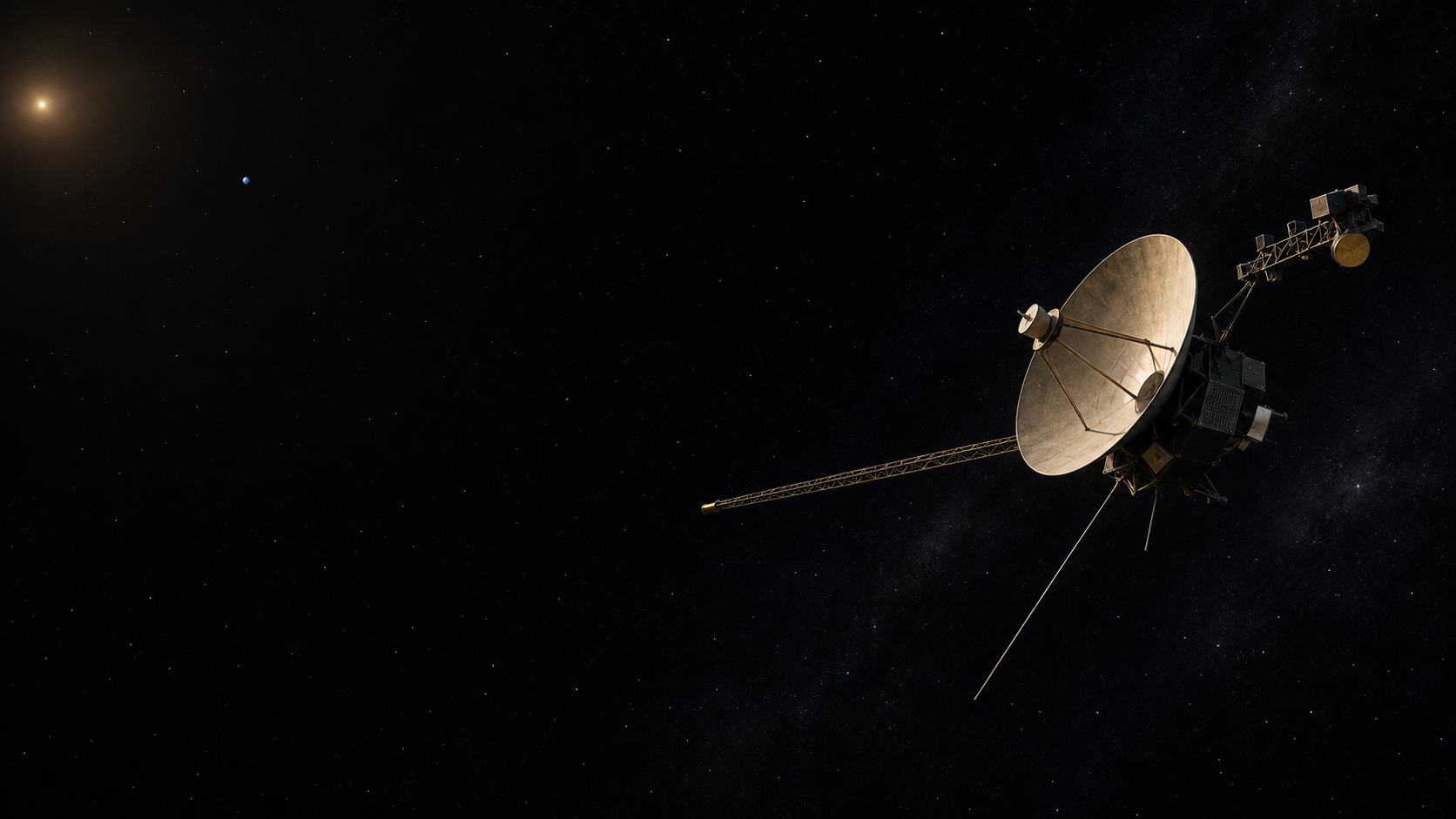
A faint radio signal from Voyager 1 has reached Earth from approximately one light-day away. The milestone shows that a spacecraft launched decades ago can still exchange information across an immense distance, even as its power supply declines and its hardware ages.
The achievement reflects Voyager 1’s endurance, the precision of NASA’s Deep Space Network, and the careful work required to operate a spacecraft that cannot respond instantly to commands. Reports describe renewed contact rather than a complete restoration of every spacecraft function Source 1.
What One Light-Day Means
A light-day is the distance light travels in 24 hours. Because radio signals travel at approximately the speed of light, a spacecraft one light-day from Earth is also about one day away in communication time.
The delay works in both directions:
- A command takes roughly one day to reach Voyager 1.
- A response takes roughly one day to return.
- A complete command-and-response cycle can require about two days, excluding processing and operational delays.
Mission controllers therefore cannot operate Voyager 1 like a nearby aircraft, satellite, or planetary rover. They must prepare every instruction with the possibility that confirmation will not arrive for many hours.
The distance continues to increase because Voyager 1 is moving away from the Sun. Its signal-travel time will gradually grow as the spacecraft travels farther into space.
Distance, the Heliosphere, and Interstellar Space
“One light-day” describes communication distance, not the spacecraft’s age or travel time. Voyager 1 did not reach its current position in one day; the term measures how far a radio signal must travel through space.
Voyager 1 is beyond the heliosphere, the vast bubble shaped by the solar wind, and is studying an environment less directly influenced by the Sun. It remains within the Milky Way and is not close to another star.
The spacecraft has entered interstellar space in the sense that it is beyond the heliosphere. However, it has not left the solar system under every definition of that term. The Sun’s gravitational influence extends much farther, through the distant Oort Cloud.
Three distances should be distinguished:
- Distance from Earth: The measurement most relevant to communication delay.
- Distance from the Sun: The spacecraft’s position relative to the solar system’s central star.
- Position relative to the heliosphere: Whether the spacecraft is inside or outside the Sun’s solar-wind bubble.
The renewed signal shows that Earth can still exchange radio information with Voyager 1. It does not mean the spacecraft has reached another stellar system.
How Voyager 1 Re-established Contact
Reports describe NASA’s achievement as a re-establishment of communication with Voyager 1 from approximately one light-day away Source 3.
In practical terms, ground teams were again able to receive a signal and communicate with the spacecraft. Renewed contact may provide information about onboard conditions, but it does not prove that every instrument or subsystem has returned to normal operation.
The distinctions are important:
- Re-established communication means that contact has resumed.
- Partial recovery means that some systems or functions are available again.
- Full mission recovery would require confirmation that relevant spacecraft systems and scientific instruments are operating as expected.
The available reports emphasize the communication milestone. They do not establish that every Voyager 1 capability has been restored.
How Deep-Space Communication Works
NASA relies on the Deep Space Network, a global system of large radio antennas that communicates with distant spacecraft. Stations around the world maintain coverage as Earth rotates.
The process generally follows these steps:
- Mission controllers prepare a command.
- A Deep Space Network antenna transmits it toward Voyager 1.
- The spacecraft receives the signal after the one-way delay.
- Voyager 1 processes the instruction using its onboard systems.
- The spacecraft transmits telemetry or other data toward Earth.
- Ground antennas receive, decode, and analyze the weak signal.
Each stage requires precision. Antennas must point accurately, frequencies must remain controlled, and ground systems must identify the spacecraft’s signal and correct errors in the returned data.
Radio energy also spreads as it travels. By the time Voyager 1’s signal reaches Earth, it is extremely weak. NASA compensates with large ground antennas, sensitive receivers, precise pointing, frequency tracking, and error-correction techniques.
Receiving a usable signal demonstrates two kinds of endurance. Voyager 1 must still generate and transmit information, while Earth-based systems must detect and interpret it across an extraordinary distance. The milestone is a combined achievement in spacecraft engineering and ground operations Source 5.
Why Voyager 1 Has Survived So Long
Voyager 1 began as a planetary exploration mission. Its early journey produced important observations of the outer solar system before the spacecraft continued toward the heliosphere and interstellar space.
Its objectives evolved during the mission. A probe designed to explore planets became a long-term observatory for the environment beyond the Sun’s protective bubble. Its continued communication represents decades of operation beyond its original planetary encounters.
Voyager 1’s endurance does not mean it has unlimited capability. Engineers have preserved its most valuable functions while adapting operations to declining resources and aging hardware.
Declining Power and Aging Electronics
Voyager 1 receives electrical power from radioisotope thermoelectric generators, which produce less energy over time. Engineers must decide which functions deserve the remaining power.
Priority systems include communications, flight computers, navigation, thermal control, and selected scientific instruments. Nonessential systems can be switched off to extend the mission, although some shutdowns may be difficult or impossible to reverse.
Aging electronics create additional risks. Memory can become harder to manage, components can degrade, and the spacecraft may return incomplete or unexpected data. Engineers must interpret those signals while working with hardware and software designed many decades ago.
Command and Troubleshooting Constraints
Voyager 1 cannot receive modern hardware upgrades. Its systems must be managed through existing computers, stored programs, and communication procedures.
Commands require extensive review before transmission. A mistake cannot be corrected immediately because the team must wait for the command to arrive and then wait again for a response. Simulations, independent checks, and conservative changes are essential.
Troubleshooting can span several days. Engineers may transmit a diagnostic instruction, wait for the spacecraft to execute it, receive telemetry, and compare the results with expected behavior.
Scientific and Historical Importance
Voyager 1 expanded knowledge of the outer solar system before becoming one of humanity’s most distant operating machines. Its later measurements provide insight into charged particles, magnetic fields, plasma, and the transition between solar and interstellar environments.
A functioning communication link is necessary before the spacecraft can return useful scientific measurements. Renewed contact does not automatically represent a new scientific discovery; mission teams must assess the returned data and instrument status first.
Voyager 1 also has cultural significance. The phrase “phones home” turns a technical event into a human-scale story: a message from an aging spacecraft crossing darkness, distance, and time.
The emotion rests on engineering facts. The signal must be generated, aimed, transmitted, detected, decoded, and understood. Awe comes from the distance; achievement comes from the precision required to cross it.
What the Milestone Shows—and Does Not Show
The renewed contact shows that:
- Voyager 1 remains capable of communicating with Earth.
- NASA’s ground infrastructure can receive a signal from an extraordinary distance.
- Decades-old spacecraft engineering can continue functioning in deep space.
- Long-term mission teams can manage aging systems.
- The Voyager mission remains operational in at least a limited communication sense Source 7.
It does not automatically prove that every scientific instrument is operating, that Voyager 1 has unlimited power, that the mission can continue indefinitely, or that the spacecraft has made a new scientific discovery.
Communication recovery, full mission recovery, and continued scientific operations are separate conditions. The latest official NASA or Jet Propulsion Laboratory update should be used for instrument-specific status.
The Future of Voyager 1
Future operations will depend on remaining electrical power, transmitter and antenna performance, flight-computer health, thermal conditions, scientific-instrument status, and NASA’s ability to support the mission.
The spacecraft’s future will be managed through prioritization rather than expansion. Every operating system consumes resources, and every command carries risk. Each confirmed signal nevertheless provides information about Voyager 1’s condition and allows engineers to make informed decisions.
Voyager 1 offers a rare long-term record of the environment far from the Sun. Even limited measurements can contribute to understanding the boundary between the solar system and interstellar space.
The mission also demonstrates the value of durable hardware, conservative engineering, thorough documentation, flexible planning, efficient power management, reliable communications, and greater onboard autonomy. Future probes traveling farther from Earth will face longer delays and weaker signals, making onboard fault detection and self-protection increasingly important.
Conclusion: A Faint Signal With a Vast Meaning
Voyager 1’s renewed contact combines three extraordinary factors: distance, age, and technical difficulty.
At approximately one light-day from Earth, a radio signal takes about a day to travel in one direction. A command and response can require roughly two days. The transmitter operates with limited power, the electronics have aged, and NASA engineers must interpret weak, delayed data from a machine designed many decades ago.
Yet the signal arrives.
That faint transmission reflects decades of engineering, careful power management, precise antenna operations, and patient mission control. Voyager 1 remains a reminder that exploration does not end when a spacecraft leaves the planets. It continues through every measurement, command, and signal that reaches Earth from the darkness.
FAQ
How far away is Voyager 1?
Voyager 1 is approximately one light-day from Earth, according to reports describing the renewed communication milestone Source 9.
The exact distance changes as the spacecraft continues moving away. This measurement refers to its distance from Earth, not simply its distance beyond the heliosphere.
How long does communication with Voyager 1 take?
A radio signal takes approximately one day to travel one way across a distance of one light-day. A command and response can therefore require roughly two days, excluding processing and operational delays.
What does re-established contact mean?
It means NASA was able to receive communication from Voyager 1 again and continue exchanging information with the spacecraft. It does not automatically mean that every onboard system or scientific instrument has been fully restored.
How can Voyager 1 still communicate after decades?
Voyager 1 was built for long-duration operation and has been managed through careful conservation of power and onboard resources. NASA’s Deep Space Network provides the large antennas and sensitive receivers needed to maintain contact.
Is Voyager 1 still collecting scientific data?
Renewed communication creates the possibility of receiving additional data, but available reports do not confirm the status of every scientific instrument. The latest NASA mission update should be consulted for instrument-specific information.
Why does Voyager 1 matter to future missions?
Voyager 1 demonstrates that durable spacecraft and long-term mission operations can produce value far beyond an original mission plan. Its communication challenges also preview the longer delays, weaker signals, limited energy, and greater reliance on onboard autonomy that future deep-space probes will face.
Related Articles
-
 What If Space and Time Are Not Fundamental?
-
 Why Potatoes Could Feed Future Moon Bases
-
 Hera’s First Close-Up Reveals a Strange Asteroid
-
 What’s Next for NASA’s Voyager 1 Probe?
-
 Psychopathic Traits Linked to 25% Higher Second-Date Odds
-
 Duck-Billed Dinosaur Beak Was as Complex as a Bird’s
-
 Webb Finds Evidence of a Rare Stellar Merger
-
 Voyager 1 Is One Light-Day From Earth
-
 Neutron Star Caught Stripping Its Companion
-
 The Great Unconformity: Earth’s Missing Billion Years
-
 Tunable Superradiant Frequency Combs Explained
-
 Signs of Eagle Predation on a 22-Kilogram Primate
-
 Why Mars Helicopters May Need a Nuclear Ride
-
 Supernova Explodes Before Astronomers’ Eyes
-
 What Outgrown Clothes Teach Us About Time
-
 The New Space Race: Promise, Progress, and Limits