Voyager 1 Is One Light-Day From Earth: What It Means
Voyager 1 Reaches One Light-Day From Earth: What the Milestone Means
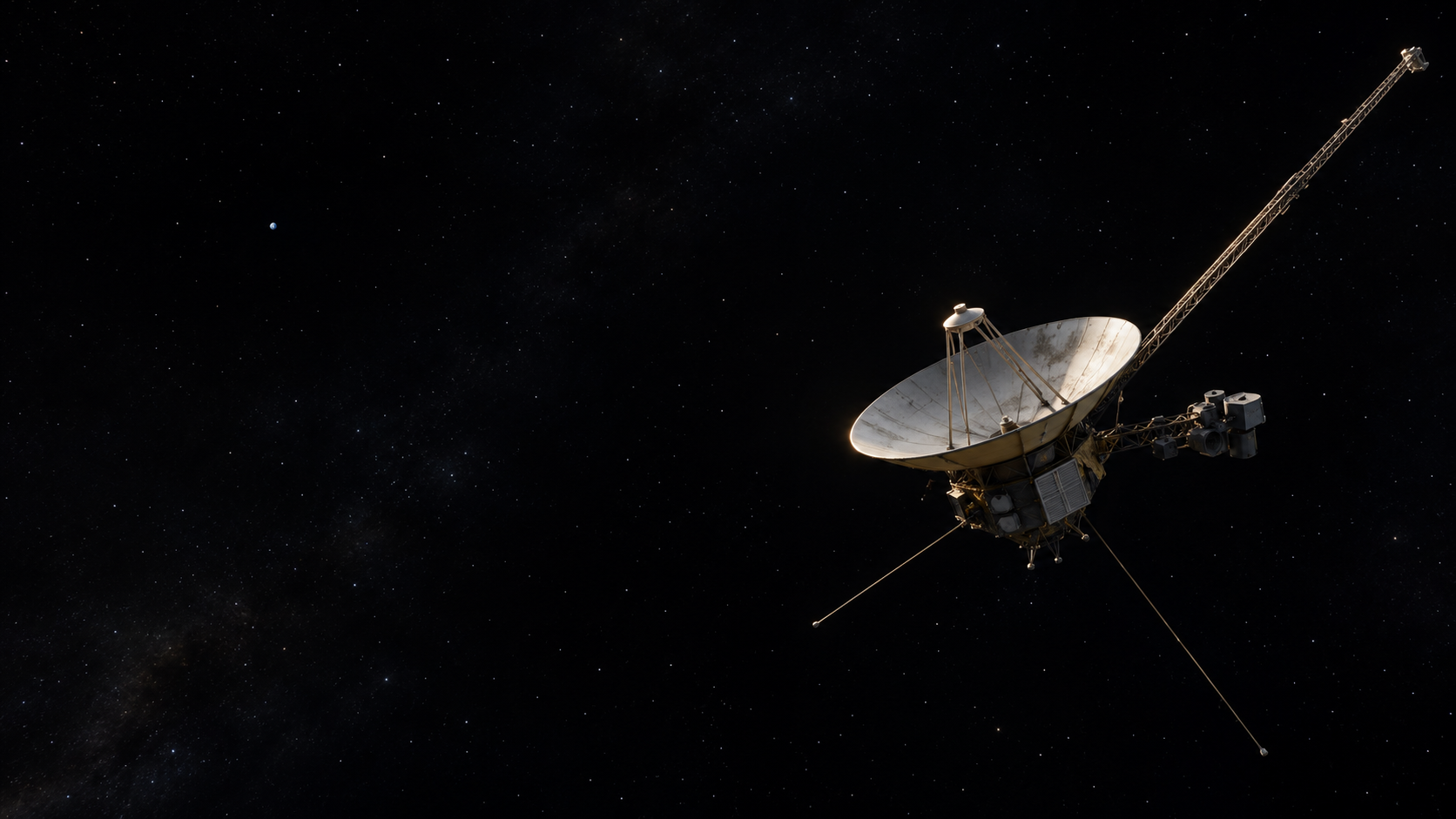
NASA’s Voyager 1 is approximately one light-day from Earth, making it the farthest human-made object from our planet. At roughly 16 billion miles (25.9 billion kilometers), the spacecraft is so distant that a radio signal takes about one day to travel between Earth and the probe Source 9.
The milestone describes distance, not travel time. Voyager 1 took decades to reach this separation because it travels far more slowly than light. Its distance also changes continuously, so estimates vary slightly according to the date, reference point, and rounding method. Outlets reporting the figure, including Spaceflight Now, Space, and USA Today, framed it the same way: a distance landmark reached in interstellar space rather than a change in how the mission operates Source 1 Source 5 Source 7.
What Is a Light-Day?
A light-day is the distance light travels through a vacuum in 24 hours: approximately 16.1 billion miles, 25.9 billion kilometers, or 173 astronomical units. An astronomical unit is the average distance between Earth and the Sun.
When Voyager 1 is described as being one light-day from Earth, light emitted near Earth would need about one day to reach the spacecraft. A signal traveling back to Earth would require a similar amount of time. The phrase does not mean that Voyager 1 traveled for one day or is one day from another planet.
For comparison, the Moon is about 1.3 light-seconds from Earth, and sunlight takes roughly 8.3 minutes to reach Earth. The nearest star system, Alpha Centauri, is more than four light-years away. Voyager 1 is not traveling toward that system.
Earth-based and Sun-based distance measurements are close but not identical because Earth orbits the Sun. For this reason, “approximately one light-day” is the most useful description.
Working the Numbers
Two conversions follow directly from the definition. Dividing 16.1 billion miles by 24 hours gives roughly 671 million miles per hour. Dividing the same distance by 86,400 seconds gives roughly 186,000 miles per second, the speed of light. The metric version works the same way: about 25.9 billion kilometers divided by 86,400 seconds yields roughly 300,000 kilometers per second.
The 173 AU figure comes from the same relationship. One light-day divided by the average Earth–Sun distance of about 93 million miles yields roughly 173 AU. These are not competing measurements; they are one distance expressed in different units, which lets a reader check any Voyager 1 claim by converting rather than trusting a single headline figure.
Why Earth’s Orbit Shifts the Figure
Earth circles the Sun at a radius of about one astronomical unit, so the Earth–spacecraft separation depends on where Earth sits in that orbit relative to Voyager 1’s direction of travel. Across a year, the measured gap varies by roughly two AU — about 186 million miles — depending on whether Earth is on the near side or the far side of the Sun. That swing is small next to 173 AU, but it is large next to the precision of radio tracking, which is why published distances carry a date and a stated reference point.
Voyager 1’s Journey
Voyager 1 launched on September 5, 1977, to study Jupiter and Saturn. It returned important observations of Jupiter’s atmosphere, Io’s volcanic activity, Saturn’s rings, Saturn’s atmosphere, and Titan.
The spacecraft used gravity assists to increase its speed and alter its trajectory. During a gravity assist, a spacecraft exchanges a small amount of momentum with a moving planet. This technique enabled Voyager 1 to leave the planetary region without carrying the enormous fuel supply required for a conventional powered escape.
NASA reported that Voyager 1 crossed the heliopause in 2012. The heliopause is the boundary where the solar wind meets the surrounding interstellar medium. Voyager 1 is therefore traveling through interstellar space, although the Sun’s gravitational influence extends much farther than the heliosphere.
Why the Gravity Assists Mattered
The assist is a trade, not a free push. The spacecraft gains speed in the planet’s frame of reference while the planet loses a minuscule, undetectable amount of orbital energy. Because the exchange happens without propellant, the maneuver changes both speed and direction at almost no cost to the spacecraft’s mass budget. A chemically powered burn that produced a comparable velocity change would have required propellant far beyond what the launch vehicle could lift, and the extra mass would have compounded through every later stage of the mission.
From Planetary Mission to Interstellar Probe
The 1977 design assumed a planetary encounter sequence, not decades of operation beyond the heliosphere. The trajectory that made the Jupiter and Saturn flybys possible also set the probe on an escape path, so the interstellar phase followed from the same geometry the mission planners intended for the outer planets. Crossing the heliopause in 2012 changed the environment being measured, not the spacecraft’s course.
Measuring Voyager 1’s Distance
Mission teams determine Voyager 1’s position through radio tracking. They analyze signal timing, Doppler shifts, antenna pointing, and trajectory models. Because the spacecraft’s signal is extremely faint, tracking requires sensitive antennas, precise timing, and careful analysis.
Voyager 1 travels away from the Sun at roughly 17 kilometers per second. It has no planned landing or orbital insertion ahead; it is coasting along an escape trajectory and will continue moving outward.
What the Velocity Means in Practice
Seventeen kilometers per second is about 38,000 miles per hour, and it accumulates to roughly 3.6 astronomical units per year. At that rate the spacecraft closes a single AU in about 100 days, which is why the light-day figure is a moving target: any published distance is a snapshot tied to a date, and the number grows steadily between snapshots.
Why Tracking Is Difficult
A radio signal spreads as it travels, so the power collected on Earth is a tiny fraction of what the spacecraft transmits. The receiving antenna must be pointed at the predicted position, and the prediction must be good enough to keep the probe inside the beam. Doppler shifts in the returned carrier reveal how the line-of-sight velocity is changing, and comparing many such measurements against a trajectory model refines the distance. Timing, pointing, and modeling are therefore not independent checks; they are inputs to a single solution.
Communication Across a One-Day Delay
A command sent from Earth takes approximately one day to reach Voyager 1. A response requires about another day to return. A typical command-and-response sequence therefore takes about two days:
- Mission controllers transmit a command.
- Voyager 1 receives and processes it roughly one day later.
- The spacecraft executes the instruction and sends telemetry.
- Ground stations receive the response roughly another day afterward.
Actual timing varies with the spacecraft’s precise distance, signal paths, processing time, and ground-station procedures. Engineers cannot operate Voyager 1 in real time. Commands require extensive testing and review because an error may not become apparent for days.
NASA communicates with Voyager 1 through the Deep Space Network, whose large antennas in California, Spain, and Australia support tracking, commanding, and data reception. The network also serves missions throughout the solar system, so communication sessions must be carefully scheduled.
What the Delay Rules Out
A one-day light time removes any possibility of joystick-style control. An operator cannot watch a reading, react, and adjust within a single session, because the state being observed is already a day old by the time it arrives. Every command is therefore closer to a scheduled script than to a live correction: the sequence must be validated on the ground before transmission, and contingency handling has to be built into the spacecraft itself. The multi-day gap also explains why anomalies take days to characterize — the first indication of a problem is already a day behind reality, and the first diagnostic command adds another day each way.
Aging Systems and Scientific Value
Voyager 1 was designed for a planetary mission, not indefinite operation in interstellar space. Its continued survival reflects conservative engineering, redundant systems, careful management, and decades of work by successive generations of engineers.
The spacecraft uses radioisotope thermoelectric generators, or RTGs, which produce electricity from heat released by radioactive decay. Their output gradually declines, leaving less power for heaters, instruments, computers, and communications. NASA has shut down or reduced nonessential systems to preserve energy.
Voyager 1’s remaining instruments study plasma, charged particles, magnetic fields, energetic particles, and cosmic rays beyond the heliopause. These direct measurements provide information about the local interstellar medium that telescopes cannot obtain in the same way.
The Power Trade-Off
Because RTG output falls monotonically, the power budget is a schedule of reductions rather than a single crisis. Each shutdown frees a margin that can be spent on heaters, transmitters, or a surviving instrument, and each choice removes a capability that is unlikely to return. Thermal control competes directly with science in that calculation: propellant lines and sensitive components must stay above their minimum temperatures, so heater power is not optional overhead. The remaining instrument suite is small precisely because it is what the shrinking supply can still support.
Why Interstellar Measurements Are Unique
Remote sensing from the inner solar system measures the interstellar medium through a column of heliospheric material. A spacecraft sitting beyond the heliopause samples the local plasma, magnetic field, and particles in place, at the cost of covering only one point along one trajectory. The value comes from that combination: a single set of direct, in-situ readings against which remote observations and models can be compared.
What Happens Next?
Voyager 1 will continue moving away from Earth and the Sun while its power and scientific capabilities gradually decline. NASA is expected to prioritize communication, thermal control, and essential spacecraft functions before turning off additional instruments and systems.
Eventually, the spacecraft will lose the ability to maintain reliable contact. It will nevertheless continue coasting through the Milky Way. The end of communication will mark the end of active mission operations, not the end of the spacecraft’s physical journey.
Because the probe is on an escape trajectory, no future maneuver depends on the current power state; the outward motion continues whatever the spacecraft can still do. The practical question for the mission is not whether Voyager 1 keeps traveling, but how long engineers can keep the transmitter, the heaters it needs, and at least some instruments inside the available power margin.
Common Misunderstandings
- Voyager 1 did not travel for one day. A light-day is a unit of distance.
- It is not one day from another planet or star. The figure describes radio-signal travel time between Earth and the spacecraft.
- Interstellar space is not empty. It contains gas, dust, plasma, magnetic fields, and cosmic rays.
- Voyager 1 has not left the galaxy. It has left the heliosphere, while the Milky Way spans roughly 100,000 light-years.
Questions and Answers
Is Voyager 1 a light-day away or a light-year away? A light-day. One light-year is more than 365 times larger, so the spacecraft is a small fraction of a light-year from Earth despite being the farthest human-made object.
Does a one-day delay mean the mission has stalled? No. The delay reflects distance. Commands and telemetry still cross the gap; they simply take about a day each way.
Why do different articles give slightly different distances? Because the separation grows continuously and because Earth-based and Sun-based measurements differ as Earth moves around the Sun. Rounding and publication date account for the rest.
Could a signal arrive faster than a day? Not in vacuum. Radio travels at the speed of light, so one light-day of separation means about one day of travel time, minus whatever small differences the exact distance at that moment provides.
Conclusion
Voyager 1’s approximate one-light-day distance from Earth is a landmark in robotic exploration. Launched in 1977 to study the outer planets, the spacecraft now travels through interstellar space and sends data across a gap that light itself needs roughly a day to cross.
Its power and instruments are declining, but Voyager 1 continues to demonstrate the reach of long-term engineering, careful mission planning, and scientific persistence.
Related Articles
-
 Supermoon 2025: What to See and When to Watch
-
 Southern California’s Role in the Lunar Economy
-
 How a Giant Star Swallowed Its Companion and Exploded
-
 NASA’s Voyager 1 Reaches One Light-Day from Earth
-
 BepiColombo’s Eight-Year Journey to Mercury
-
 Could Known Particle Physics Explain Dark Energy?
-
 Nearby Triple-Star System That “Shouldn’t Exist” Explained
-
 How Science Can Prevent a Biological Apocalypse
-
 Voyager 1 Reaches One-Light-Day Milestone
-
 Welopōʻai: A Triple-Star System 28 Light-Years Away
-
 Star Eating Its Companion: What the Images Reveal
-
 Potatoes Grown in Simulated Moon Soil: Why It Matters
-
 BepiColombo’s Mercury Orbit Insertion Explained
-
 Leonid Meteor Shower 2026: How to Watch the Peak
-
 How Failed Supernovae May Create Black Holes
-
 Gravity Messaging: What the Elevator Experiment Shows