Possible Second Earth-Like World Beyond Neptune
Possible Second Earth-Like World Beyond Neptune
Astronomers have identified tentative evidence that an undiscovered planet may orbit in the distant outer Solar System. The object has not been directly observed, photographed, or confirmed. Researchers inferred its possible existence from unusual orbital patterns among small bodies beyond Neptune.
Some reports have described the object as a possible “second Earth-like world beyond Neptune.” That phrase requires caution. Scientists do not yet know the candidate’s size, mass, composition, atmosphere, temperature, or surface conditions. No evidence indicates that it is habitable or contains life.
The narrower scientific claim is that an unseen planet may be influencing the motion of distant icy objects. If future observations confirm that interpretation, the discovery would add a new member to the Solar System and could alter models of planetary formation and migration.
The proposal also differs from the well-known Planet Nine hypothesis. Researchers searching for Planet Nine may have found evidence pointing instead to a planet with a different orbit or physical profile. Both possibilities remain unconfirmed.
What Astronomers May Have Found
Evidence of an Unknown Planet’s Gravitational Influence
Astronomers can sometimes detect a planet without seeing it directly. A sufficiently massive object changes the paths of smaller bodies through gravity. Researchers study those movements and test whether the known planets adequately explain them.
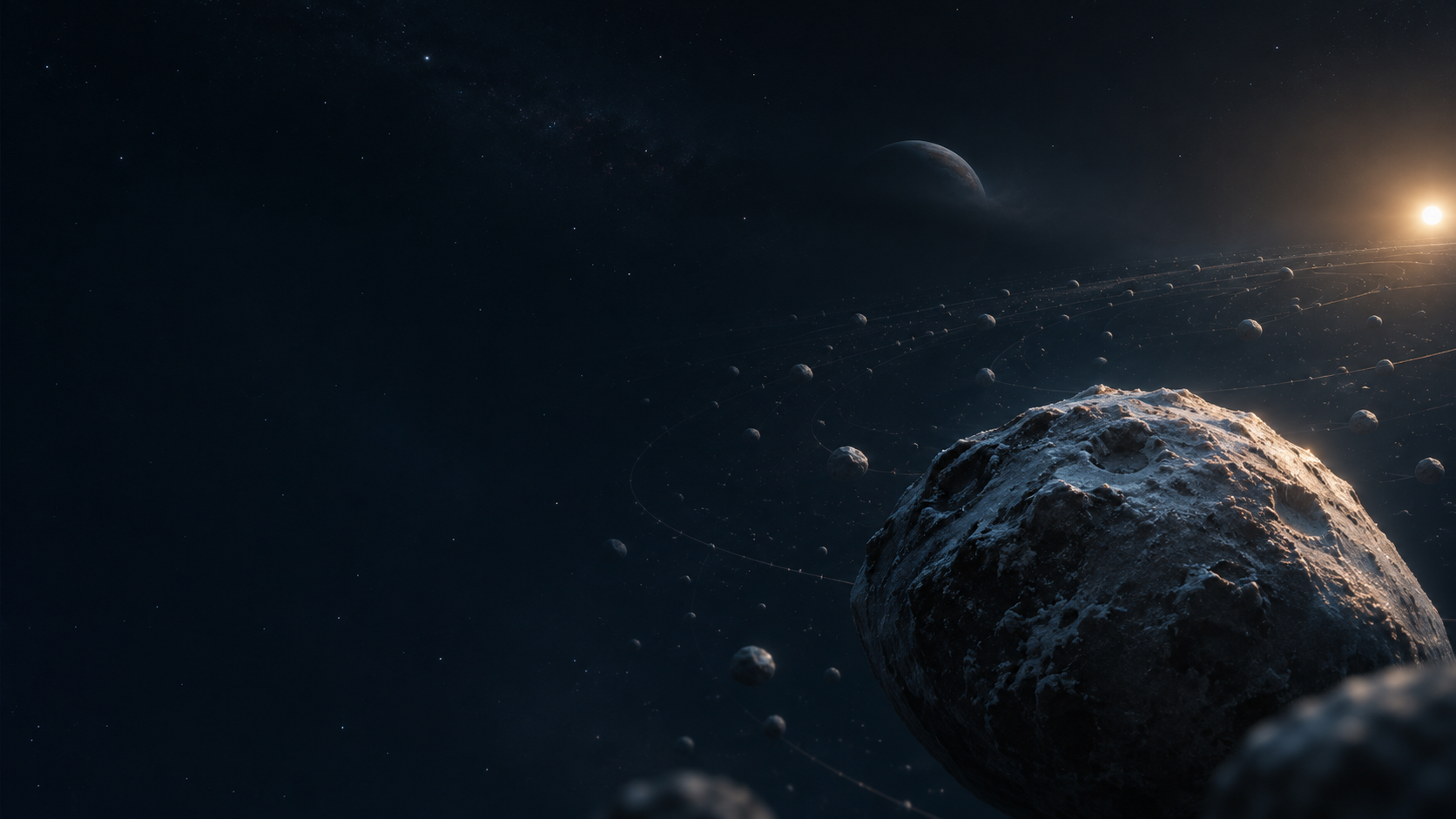
The current evidence involves unusual orbital behavior among distant trans-Neptunian objects. These bodies occupy regions beyond Neptune and often follow elongated, inclined, or otherwise unusual paths around the Sun. If several objects share related orbital characteristics, their distribution may suggest the influence of a larger unseen body.
Possible clues include:
- Similar orientations among distant orbits
- Unexpected clustering among icy objects
- Orbital shapes that are difficult to explain using only the known planets
- Patterns that could result from an unknown source of gravity
A planet is not the only possible explanation. Apparent clustering can result from observational bias if telescopes detect some orbital paths more easily than others. The sample of known distant objects is also small, and statistical chance can create patterns that disappear as more objects are discovered.
Other explanations include the combined gravitational effects of known planets, smaller unseen bodies, or limitations in current models. The proposed planet should therefore be treated as a hypothesis, not a discovery.
The Planet Has Not Been Directly Seen
Direct detection means identifying light from the object. A telescope might observe sunlight reflected from its surface or heat emitted at infrared wavelengths. The current proposal does not meet that standard.
Instead, astronomers are inferring the planet from its possible gravitational effects. This method has a long history in astronomy: scientists used irregularities in the motion of known bodies to predict planets before observing them directly. However, an inference becomes convincing only when the data are strong, the model makes accurate predictions, and independent observations support it.
The candidate’s existence requires additional testing. Astronomers need longer observation records, improved measurements of distant objects, and targeted searches for the suspected planet itself.
Why the Possible World Is Being Compared With Earth
“Earth-Like” Does Not Mean Habitable
The phrase “Earth-like” is often used broadly in popular science coverage. It may refer to an estimated size, a possible rocky composition, or a mass comparable to Earth. It does not automatically mean that a planet has oceans, a breathable atmosphere, moderate temperatures, or life.
There is currently no reliable information about the proposed world’s:
- Surface conditions
- Atmospheric composition
- Temperature
- Water inventory
- Geological activity
- Magnetic field
- Potential biological environment
No observation has demonstrated that the object is rocky. Researchers have not measured its atmosphere or detected chemical evidence associated with life. The available evidence concerns its possible gravitational influence, not its habitability.
A Distant Planet Would Face Extreme Conditions
A planet beyond Neptune would receive far less sunlight than Earth. Solar energy weakens rapidly with increasing distance, so its surface could be extremely cold. Water and other volatile substances might exist mainly as ice, although internal heat or unusual atmospheric conditions could create more complex environments.
The object might also have a very long year. A distant orbit could take hundreds or thousands of Earth years to complete. Seasonal changes would occur over long periods, and sunlight would remain weak even during the planet’s closest approach to the Sun.
These conditions would not make the planet scientifically unimportant. A cold world could preserve material from the Solar System’s formation, reveal how planets migrate, and provide evidence about the distribution of matter in the Sun’s outer system. However, “Earth-like” should not be interpreted as “another habitable Earth.”
How This Finding Differs From Planet Nine
The Planet Nine Hypothesis
Planet Nine is a proposed planet that some researchers believe may orbit far beyond Neptune. The hypothesis emerged from the unusual orbital properties of several distant trans-Neptunian objects. According to the model, a large planet could shepherd or align those objects through its gravitational influence.
Planet Nine has not been directly detected. Its possible orbit remains uncertain, and the object could be located in a large, faint, difficult-to-search region of the sky. Astronomers continue to examine archival data and conduct new observations in the search for it.
The Planet Nine idea remains an active scientific hypothesis, not a confirmed planetary discovery.
A Different Planet Could Explain the Data
Recent research discussed in reports about the outer Solar System may point to a planet with characteristics different from the standard Planet Nine proposal. This does not confirm Planet Nine, disprove it, or establish a separate planet. It indicates that different models may explain the available orbital data.
Key questions include:
- Are the observed patterns caused by one large, distant planet?
- Could a smaller planet produce the same effects?
- Might the object occupy a different orbit from the proposed Planet Nine?
- Are the patterns caused by observational selection effects?
- Could several smaller bodies create a similar gravitational signature?
The answers depend on future observations and statistical analysis. The two hypotheses should not be presented as confirmed competing discoveries. Both require stronger evidence.
Why Finding Planets Beyond Neptune Is Difficult
The Outer Solar System Is Extremely Dark
Sunlight is already weak at Neptune’s distance. Farther out, a planet would receive and reflect even less light. Its apparent brightness could be extremely low, especially if it has a dark surface or small size.
A faint planet may be hidden among background stars and galaxies. Telescope noise, atmospheric distortion, and image-processing limitations can make the search harder. A single image rarely provides enough information to distinguish a distant planet from an unrelated background source.
The Planet May Move Very Slowly Across the Sky
A nearby asteroid can shift noticeably between images taken on different nights. A much more distant planet may appear nearly stationary over the same period. Its movement may be too subtle to identify without comparing images separated by weeks, months, or years.
Astronomers use repeated imaging to search for objects that move consistently against the background sky. Automated software can compare large numbers of images, but it must account for false detections, image artifacts, variable stars, and background galaxies.
Once a candidate is identified, researchers need additional observations to determine whether it follows a genuine orbit.
Orbital Uncertainty Increases With Distance
A planet with a very long orbital period is difficult to locate because astronomers observe only a tiny portion of its path. A small error in its estimated distance, direction, or orbital shape can shift its predicted position across a large region of the sky.
Instead of searching one precise location, astronomers may need to examine broad areas. The object could also be near the faintest limit of a survey’s instruments. These challenges explain why direct confirmation may take years.
How Astronomers Could Confirm the Candidate
More Observations of Distant Objects
The first priority is expanding the sample of known trans-Neptunian objects. Researchers can test whether the apparent orbital clustering remains visible as more objects are discovered.
A reliable analysis must address observational bias. Surveys should cover different parts of the sky and use methods that do not favor particular orbital orientations. Researchers also need longer tracking periods so that the positions and paths of known objects become more precise.
If the same pattern persists across independent datasets, the gravitational explanation becomes more credible. If the pattern weakens as the sample grows, the original signal may have resulted from limited data or selection effects.
Direct Telescope Searches
Astronomers can use wide-field optical surveys to search for faint, moving objects. Repeated imaging allows computers to identify sources that shift slowly relative to background stars.
Infrared observations may also be valuable. A distant planet would reflect little sunlight, but it could emit a small amount of thermal radiation. Infrared instruments might detect that heat if the object is sufficiently large, warm, and close enough for current telescopes.
Potential search methods include:
- Wide-field optical imaging
- Infrared observations
- Repeated exposures
- Automated slow-motion searches
- Examination of archival telescope data
- Targeted observations based on predicted orbital regions
A direct image would provide stronger evidence, but it would not immediately answer every question. Astronomers would still need to measure the object’s orbit, brightness, color, mass, and physical properties.
Independent Verification
Independent research teams should analyze the data and test the proposed model. This process can determine whether the orbital pattern is statistically significant and whether the predicted planet improves the explanation of the observations.
Researchers will also compare the planet hypothesis with alternatives. A model is more persuasive when it explains the data without excessive assumptions and makes predictions that later observations confirm.
A confirmed planet would need a reliable orbit. Additional measurements would help establish whether the object is gravitationally bound to the Sun and distinguish it from a distant background source.
What the Finding Could Mean for Solar System Science
A More Complicated Solar System
The Solar System may contain undiscovered worlds in regions that are faint, distant, and difficult to survey. A confirmed planet beyond Neptune would demonstrate that the known planetary census remains incomplete.
The discovery could affect models of:
- Planet formation
- Early planetary migration
- Gravitational interactions
- The structure of the Kuiper Belt
- The distribution of distant icy bodies
Its orbit could preserve clues about the Solar System’s early history. The planet may have formed closer to the Sun and moved outward, or it may have interacted with other planets during a chaotic early period.
New Limits on Planet Formation Models
A large planet far beyond Neptune would challenge some existing formation models. Researchers would need to explain how it accumulated enough material, reached its current orbit, and remained gravitationally bound to the Sun.
Possible scenarios could involve outward migration, interactions with the giant planets, or encounters with other stars during the Sun’s early history. The planet’s mass and orbit would be essential for testing these possibilities.
A smaller world would create a different challenge. Scientists would need to determine whether a relatively low-mass planet could produce the observed orbital effects and survive in the outer Solar System for billions of years.
Better Understanding of Trans-Neptunian Objects
Distant icy bodies act as records of the Solar System’s gravitational history. Their orbital shapes and orientations reflect interactions with planets, passing stars, and other objects.
A confirmed planet could help explain why some trans-Neptunian objects have unusually tilted, elongated, or clustered orbits. It could also reveal that the outer Solar System is more dynamically structured than current maps suggest.
What This Means for the Search for Life
A New Planet Is Not Evidence of Life
The possible planet beyond Neptune has no reported biological signature. Detecting a planet and detecting life are separate scientific achievements.
Researchers would first need to establish the object’s existence and determine its basic properties. They would then need evidence about its atmosphere, chemistry, energy sources, and possible surface or subsurface environments. None of that information is currently available.
Its distance from the Sun would probably make surface conditions cold and sunlight scarce. That does not completely rule out unusual forms of habitability, such as environments powered by internal heat, but there is no evidence that such conditions exist on this candidate.
Lessons From JWST Exoplanet Research
The James Webb Space Telescope has advanced the study of exoplanet atmospheres by allowing astronomers to analyze light passing through or emitted by distant worlds. Atmospheric chemistry can be affected by clouds, hazes, stellar activity, and chemical reactions unrelated to life. A detected molecule may have several possible origins.
LHS 1140b illustrates why atmospheric observations matter. Reports describe evidence for an atmosphere around this Earth-like exoplanet, which could help researchers investigate its composition and potential habitability. An atmosphere, however, is not proof that a planet supports life.
Observations of K2-18 b have also generated discussion about possible dimethyl sulfide and dimethyl disulfide signals in its atmosphere. Researchers have emphasized that these results require further observations and that non-biological explanations must be examined. The reported molecules are not proof of life.
JWST researchers have revised their strategies as they learn more about atmospheric false positives, clouds, hazes, and stellar behavior. The same principle applies to the possible planet beyond Neptune: headlines can move faster than evidence. Scientific conclusions require confirmation, context, and explicit treatment of uncertainty.
What Happens Next
Immediate Research Priorities
Astronomers are expected to:
- Continue observing distant trans-Neptunian objects.
- Improve measurements of their positions and orbital paths.
- Refine the possible planet’s mass and orbital parameters.
- Search targeted regions of the sky.
- Compare results from independent surveys.
- Test whether alternative models explain the data better.
Possible Outcomes
Several outcomes remain possible. A faint planet could be directly detected, strengthening the gravitational interpretation. New observations could also show that the orbital pattern is more significant than first thought.
The evidence could weaken as more distant objects are discovered. Researchers might conclude that observational bias, limited data, or another dynamical mechanism produced the initial signal.
If a planet is confirmed, astronomers would establish its orbit and eventually assign an official designation under the standard planetary naming process.
Conclusion: A Promising Lead, Not a Confirmed Second Earth
Astronomers have reported tentative evidence for an unknown planet beyond Neptune, based on unusual orbital patterns among distant Solar System objects. The candidate has not been directly observed, and its existence remains unconfirmed.
The phrase “second Earth-like world beyond Neptune” should be treated cautiously. No evidence currently establishes the object’s size, composition, atmosphere, temperature, habitability, or biological potential. The available evidence concerns gravity, not life.
A confirmed planet would still be a major discovery. It could reveal a new member of the Solar System, test theories of planetary formation, and improve understanding of distant icy bodies. For now, the next steps are observation, modeling, direct searches, and independent verification—not a claim that a habitable second Earth has already been found.
Frequently Asked Questions
Is there really a second Earth beyond Neptune?
Astronomers have reported tentative evidence for a previously unknown planet beyond Neptune, but its existence has not been confirmed. No evidence shows that it is Earth-like in composition or capable of supporting life.
Is this possible planet the same as Planet Nine?
Not necessarily. The reported evidence may point to a planet with characteristics or an orbit different from those proposed for Planet Nine. Both remain unconfirmed hypotheses.
How do astronomers detect a planet they cannot see?
They study the possible gravitational effects of the planet on smaller, distant objects. Unusual orbital patterns can suggest that an unseen mass is influencing those objects. Direct telescope observations are still needed for confirmation.
Could the possible planet support life?
There is not enough information to assess its habitability. Its distance from the Sun would likely mean low temperatures and weak sunlight. Researchers have no confirmed evidence of an atmosphere, liquid water, or biological activity.
When will scientists know whether the planet exists?
There is no fixed timeline. Confirmation depends on new observations, improved orbital calculations, direct detection, and independent verification. The process could take years because the object may be extremely faint and slow-moving.
Does this finding prove that life exists beyond Earth?
No. A possible planet beyond Neptune would be evidence of a potential new Solar System object, not evidence of life. Even atmospheric signals reported for exoplanets such as K2-18 b require further observations before scientists can determine whether they have a biological origin.
Related Articles
-
 BepiColombo Mercury Arrival Uncertain After Software Issue
-
 2,000+ Arthropod Species Found in North American Homes
-
 Rare Triple-Star System 28 Light-Years Away
-
 BepiColombo Has Not Yet Entered Mercury’s Orbit
-
 Supermoon and the Seven Sisters: A Skywatching Guide
-
 Galactic Shock Challenges Milky Way Structure Models
-
 Jupiter’s Swirls and Colors from NASA’s Juno
-
 Fireball Streaks Over Western New York
-
 JWST Finds a Black Hole Outgrowing Its Galaxy
-
 A Possible Second Hidden World Beyond Planet Nine
-
 Einstein Was Right: Black Hole Image Confirms Relativity
-
 Potatoes Grow in Simulated Lunar Soil
-
 Why the Right Brain Controls the Left Body
-
 Inside SpaceX’s Starfactory: Where Starship Takes Shape
-
 BepiColombo: Europe and Japan’s Mission to Mercury
-
 Earth’s Temporary Mini-Moon: What We Know