Kerch Bridge Attack: What Is Confirmed and Unknown
Kerch Bridge Attack: What Is Confirmed and Unknown
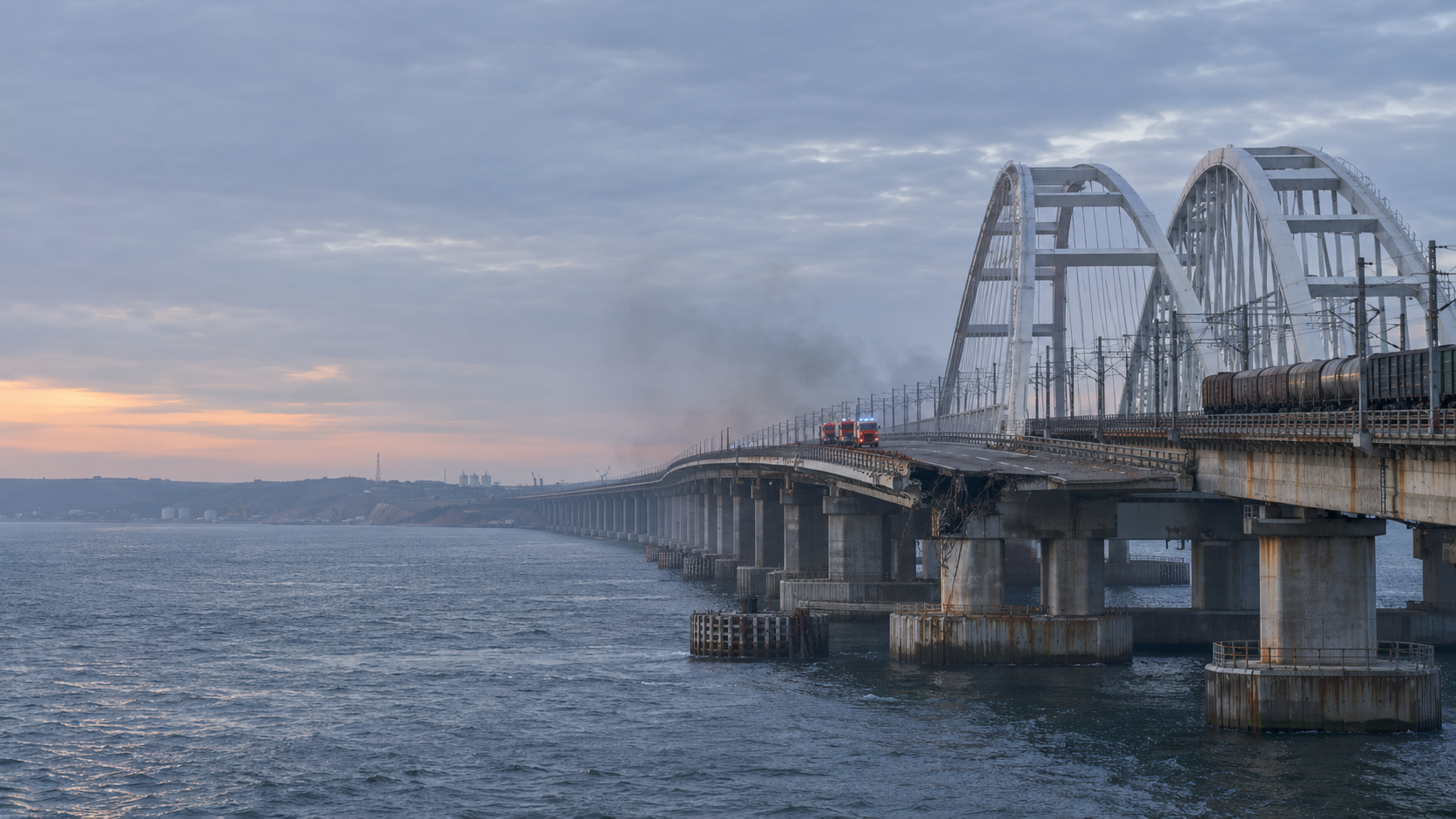
Reports that the bridge connecting Russia with occupied Crimea has been hit again have renewed attention on one of the most important and politically sensitive pieces of infrastructure in the Russia–Ukraine war.
The Kerch Bridge crosses the Kerch Strait between Russia’s Krasnodar region and the Crimean Peninsula. It carries road and rail traffic and serves civilians, commercial transport, and military logistics. Russia presents the bridge as a permanent link with Crimea. Ukraine and most of the international community regard Crimea as Ukrainian territory under Russian occupation.
The latest incident remains difficult to assess. The supplied material includes no verifiable source, date, imagery, official statement, damage assessment, casualty report, or transport notice. The method of the reported attack, the affected section, the level of damage, and the operational consequences should therefore not be treated as confirmed.
What Is the Kerch Bridge?
The Kerch Bridge is a major road and rail crossing over the Kerch Strait. It connects mainland Russia, particularly the Krasnodar region, with the Crimean Peninsula.
The crossing includes road and railway infrastructure, approaches, inspection areas, and supporting facilities on both sides of the strait. Damage to one section, access road, railway component, or security area could affect the wider operation of the crossing even if the main structure remains physically intact.
Road and rail traffic may also be affected differently. A disruption to the roadway may not halt railway operations, while damage to shared approaches, inspection areas, or support systems could create broader restrictions.
No reliable information in the supplied material identifies which section was reportedly affected. Claims about a specific span, railway line, roadway, pier, or nearby facility require confirmation through current imagery or official transport information.
Political and Symbolic Importance
Russia treats the bridge as a permanent physical and political link between the country and Crimea. Its construction and continued operation support Moscow’s claim that the peninsula is integrated into Russia.
Ukraine rejects Russia’s annexation of Crimea and considers the bridge part of the infrastructure supporting the occupation. The crossing is therefore more than a transport route. It is also a symbol of Russian control and a prominent wartime target.
An incident involving the bridge attracts attention beyond its immediate physical effects. Any disruption could affect public confidence, military planning, civilian travel, and political messaging. It could also become part of competing narratives about Russia’s ability to protect critical infrastructure and Ukraine’s ability to reach targets far from the front line.
What Happened in the Latest Reported Attack?
Confirmed Information
The available source material does not provide verifiable information about the latest reported incident. It does not establish:
- The date or time.
- The location on or near the bridge.
- The method used.
- The number of impacts or explosions.
- The extent of structural damage.
- Whether road traffic was suspended.
- Whether rail traffic was suspended.
- Whether casualties occurred.
- Whether military equipment or cargo was affected.
- Which party was responsible.
The safest description is that the bridge has reportedly been hit or disrupted again, while the central facts remain unconfirmed.
Reports should identify their sources carefully. Phrases such as “Russian authorities reported,” “Ukrainian officials stated,” or “independent imagery appeared to show” distinguish a claim from an established fact. If no independent evidence exists, that limitation should be stated directly.
Claims That Remain Unverified
The method remains unknown. The incident could involve missiles, drones, explosives, sabotage, falling debris, or another cause. A flash, smoke plume, or explosion in a video does not establish the weapon or actor involved.
The extent of any damage is also unclear. An impact could affect the road surface, railway infrastructure, bridge supports, inspection facilities, or nearby military and security installations. Distant images may not reveal damage beneath the roadway or to load-bearing components.
The bridge’s operating status is unknown. Authorities may close the crossing temporarily for inspections even when engineers later determine that the structure remains usable. It could also remain partially open while operating below normal capacity.
No casualty information can be confirmed from the supplied material. There is no verified evidence showing whether military personnel, vehicles, fuel, ammunition, or other supplies were present or affected.
Early battlefield reporting can change because authorities restrict access, images are recycled or misidentified, inspections are incomplete, or Russian and Ukrainian officials publish competing accounts that serve different political and military objectives.
Official Responses from Russia and Ukraine
No attributable Russian or Ukrainian statement about the latest incident is included in the supplied source material. Claims about air defenses, attempted attacks, damage, casualties, traffic restrictions, or responsibility require direct verification.
Russian authorities could announce temporary closures, security inspections, convoy controls, or restrictions on photography near the bridge. Such measures would indicate a security response but would not, by themselves, reveal the scale of physical damage.
Ukrainian officials might confirm, deny, or avoid directly commenting on the incident. Ukraine has previously described infrastructure linking Russia with occupied Crimea as connected to Russia’s military operations. A political statement about the bridge’s military importance, however, would not independently prove how the latest incident occurred.
Independent investigators can add context through geolocated video, satellite imagery, transport data, and analysis of bridge access points. Confirmation is stronger when several independent forms of evidence support the same conclusion.
Why the Kerch Bridge Matters in the War
Military Logistics
The bridge can support the movement of fuel, ammunition, vehicles, personnel, repair equipment, and other supplies between Russia and Crimea. Its role depends on the condition of its road and rail links, alternative routes, and military demand at a given time.
It is not necessarily the only route available to Russian forces in or near Crimea. Land corridors through occupied areas of southern Ukraine and maritime routes can provide alternatives. These routes may be slower, less efficient, or more exposed to attack, but a bridge disruption would not automatically stop all military logistics.
The effect of an incident depends on its duration and severity. A short inspection could create delays without changing supply patterns. A prolonged closure of both road and rail traffic could require larger logistical adjustments.
Civilian Transport
The bridge also affects residents, tourists, commercial drivers, and emergency services. A temporary closure can create queues, delays, rerouting, and pressure on ferries or alternative roads.
Travel restrictions may be introduced for public safety rather than because of confirmed structural failure. Authorities may also limit movement while searching for additional threats. The public impact depends on how long restrictions remain in place and whether one or both transport systems are affected.
Longer disruptions could affect food deliveries, fuel distribution, medical transport, and local businesses. These consequences should not be assumed immediately after a reported incident; they depend on verified operating conditions and available replacement routes.
Political and Psychological Impact
Another reported incident could challenge Russian claims that the bridge is secure. It may raise concern among residents and visitors in Crimea and southern Russia, while giving Ukraine a symbolic demonstration of reach if responsibility is later established.
The psychological impact may exceed the immediate physical damage. A bridge that represents Russian control becomes a high-profile measure of wartime security. Its broader strategic effect, however, cannot be assessed without knowing whether the incident caused lasting disruption.
Previous Incidents and Disruptions
The Kerch Bridge has previously been associated with major incidents and periods of restricted traffic. The supplied material does not provide a verified chronology or source links for those events.
Historical reporting should be separated from the latest report. Each incident requires its own assessment of:
- The date.
- The reported method.
- The affected infrastructure.
- The duration of disruption.
- Official attribution.
- Independent evidence.
- The separate effects on road and rail traffic.
Following earlier incidents, authorities have reportedly increased security through checkpoints, surveillance, maritime patrols, traffic controls, and restrictions on photography. Reports of air-defense deployments or expanded patrols require careful sourcing.
Stronger security can reduce some risks but cannot eliminate vulnerability. A long bridge crosses an exposed maritime area and depends on approaches, inspection zones, communications, and transport coordination. An attacker does not necessarily need to destroy the entire structure to create delays or political pressure.
Repairs can affect road traffic, rail schedules, freight movements, and military logistics. The visible condition of a bridge does not always reveal hidden damage to supports, joints, foundations, or load-bearing elements. Repair estimates should therefore come from engineering assessments or official documentation. Temporary closures may last longer than physical repairs because of security sweeps, investigations, or new operating rules.
How to Assess Reports About the Kerch Bridge
Readers should prioritize:
- Official statements with clear attribution.
- Reputable news organizations.
- Geolocated photographs and videos.
- Recent satellite imagery.
- Transport and maritime data.
- Independent conflict-monitoring groups.
- Engineering assessments.
Anonymous social media posts can provide leads but should not be treated as confirmation. Publication times also matter. An image uploaded after an incident may have been recorded earlier, and an old report may be recirculated as breaking news.
Visual material should be checked against the bridge’s geography and physical features, including road markings, support structures, coastlines, buildings, signs, weather, lighting, vehicle positions, and camera perspective. Matching damage from more than one angle provides stronger evidence.
Reverse-image searches and frame-by-frame comparisons can identify recycled content. Videos may be edited, cropped, or presented without their original date and location. A single video rarely proves the method of an attack, the extent of damage, or responsibility.
Visible damage does not automatically mean total closure. Conversely, limited visible damage can create major delays if it affects inspections, rail systems, safety controls, or access routes. Road and rail operations may be affected differently, and temporary inspections may last longer than repairs.
Possible Consequences
Short-Term Effects
Possible immediate effects include:
- Temporary traffic suspension.
- Security inspections.
- Long queues.
- Delayed crossings.
- Route diversions.
- Pressure on ferry services.
- Delayed commercial deliveries.
- New warnings for civilian travelers.
These are possible consequences, not confirmed outcomes of the latest incident. Their likelihood depends on the bridge’s actual condition and official restrictions.
Military Consequences
A prolonged disruption could complicate logistics to Crimea and increase reliance on land corridors or maritime routes. Military planners might need to change schedules, use alternative supply paths, or add security measures to transport movements.
The bridge’s military importance does not mean that one incident changes the overall balance of the war. That conclusion would require evidence about the disruption’s duration, alternative routes, and the volume of supplies normally moved across the crossing.
Economic and Regional Consequences
Longer restrictions could affect tourism, freight, fuel distribution, food supplies, local businesses, insurance costs, and transport prices. Businesses dependent on predictable crossings may face delivery delays or higher costs. Residents could experience supply pressures if alternative routes cannot absorb the traffic.
Security and Escalation Risks
A reported attack could prompt more air-defense activity, expanded security restrictions, maritime patrols, or limits on civilian movement near the bridge. It could also contribute to retaliatory strikes or broader tensions around Crimea and the Black Sea.
Retaliation should not be treated as certain. Any escalation depends on attribution, political decisions, military opportunity, and the wider state of the war.
What Remains Unknown?
The supplied source material cannot confirm:
- The exact date and time.
- The cause and method of the incident.
- The precise location of any damage.
- Whether the road, railway, or both were affected.
- Whether support structures sustained damage.
- Whether casualties occurred.
- Whether military cargo or personnel were involved.
- How long restrictions will last.
- Which party conducted the operation.
- Whether independent evidence supports official claims.
- Whether the incident represents a temporary interruption or part of a wider infrastructure campaign.
These questions should remain open until reliable evidence becomes available.
Conclusion
The Kerch Bridge is a transportation link, a potential military logistics route, and a major political symbol. A reported new incident therefore matters even before the full facts are known.
Its strategic significance depends on verified damage, the duration of any closure, the effect on road and rail traffic, the availability of alternative routes, and credible evidence about responsibility. Without those details, definitive claims about military impact or escalation are premature.
Readers should follow current statements from authorities, reputable news organizations, transport agencies, independent investigators, and satellite or geolocation analysts. Early claims may change as inspections continue and additional evidence emerges.
Frequently Asked Questions
What is the Kerch Bridge?
The Kerch Bridge is a road and rail crossing over the Kerch Strait connecting Russia’s Krasnodar region with the Crimean Peninsula. Russia treats it as a link to Crimea, while Ukraine and most of the international community consider Crimea occupied Ukrainian territory.
What happened in the latest reported attack?
Reports indicate that the bridge was hit or disrupted again. The supplied material does not verify the date, method, affected section, damage level, casualties, or duration of transport restrictions.
Who carried out the attack?
Responsibility is not confirmed. Russian and Ukrainian officials may issue competing claims, but attribution requires credible evidence and, where possible, independent verification.
Why is the Kerch Bridge strategically important?
The bridge has civilian, military, economic, and symbolic value. It supports transport between Russia and Crimea and may carry supplies, vehicles, and personnel. Disruption can create delays and increase reliance on alternative routes.
Is the Kerch Bridge open?
Operating conditions can change quickly after a security incident. Authorities may impose temporary closures, inspections, or restricted traffic. Current official transport notices and reputable reporting are more reliable than unverified social media updates.
Could the incident escalate the war?
It could increase tensions, security measures, and the risk of retaliation. The eventual impact depends on verified damage, attribution, and the responses of Russia and Ukraine. Escalation remains a possibility, not a confirmed outcome.
Related Articles
-
 Google Reportedly Rejects UK Request to Remove Russell Brand Video
-
 Trump Departs China After Reported Xi-Putin Summit
-
 ICJ Myanmar Rohingya Genocide Case: What Comes Next
-
 Musk Calls $446 Million Midterm Spending "Pretty Foolish"
-
 Central Florida Flash Flooding Threatens Residents
-
 Alsobrooks, Van Hollen Senate Leadership Dispute
-
 Arrest Reported in Costa Rica Killing of American
-
 Over a Foot of Rain Floods South Florida
-
 Ericka Lomick Texas House Win Faces Court Challenge
-
 Maryland Students Sue Over AI Doritos Gun Mistake
-
 Trump, Xi and Putin: APEC Meeting Explained
-
 What the Crimean Bridge Attack Means for Russia
-
 Iran Warns Bahrain Over U.S. Fifth Fleet Presence
-
 Israeli Tanks Reportedly Cross Gaza’s Yellow Line
-
 Why Trump, Xi and Putin’s Summit Won’t Be Yalta 2.0
-
 Rwanda Migrant Hub Plan Faces Human Rights Backlash